Affiliate Disclosure: This site contains affiliate links. If you book through these links we may earn a small commission, at no extra cost to you.
Cairn de Barnenez: Complete Visitor Guide 2026
The Cairn de Barnenez is the largest megalithic monument in Europe — a vast stepped burial mound on the Kernéléhen peninsula above Morlaix Bay, built approximately 6,500 years ago by the first settled people of Brittany. It is 2,000 years older than the Great Pyramid of Giza and 2,500 years older than Stonehenge. André Malraux, French novelist and Minister of Culture, called it the “Prehistoric Parthenon.” Pierre-Roland Giot, the archaeologist who excavated it, described it as one of the most important architectural witnesses to the essential phase of Western European civilisation. It came within days of being obliterated entirely by a road-building contractor in 1955.
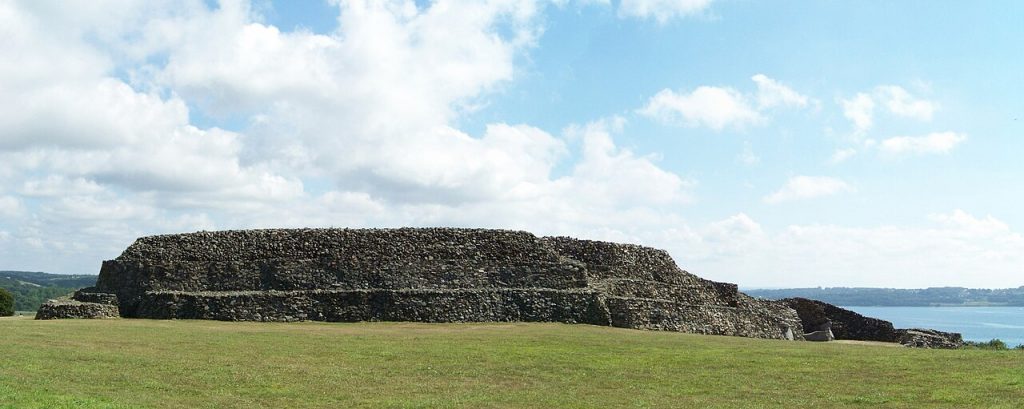
Standing on the headland above Térénez cove, the cairn is 72 metres long, up to 25 metres wide, and 9 metres tall — a stepped structure of dry-stone construction that covers eleven burial chambers, each reached by a stone-lined corridor. The chambers are oriented to face the rising sun. Inside, the walls of several corridors bear engravings: axe blades, bows, shield symbols, and zigzag motifs carved by Neolithic hands that are among the oldest decorative art in France. Chamber H contained the only painted decoration anywhere in the cairn. From the terrace beside the monument, the view across Morlaix Bay to the Sept Îles archipelago on the horizon is one of the finest in northern Finistère.
From Roscoff, the Cairn de Barnenez is just 15 kilometres and 20 minutes by car — one of the most easily combined half-day excursions from the ferry port. This guide covers everything: verified 2026 prices and opening hours, the guided tour, the extraordinary near-destruction story, how to read what you are looking at on site, and how to combine the visit with the Château du Taureau for a full Morlaix Bay day.
Last updated: May 2026 | All prices and opening hours verified from barnenez.fr official site
The Prehistoric Parthenon — 20 Minutes from Roscoff
Europe’s largest megalithic monument | Built c.4,500 BC | 11 burial chambers | €7 adults (€5.50 with Brittany Ferries ticket) | FREE under-18s | Free guided tour included | Morlaix Bay views | Free parking
Construction date
2,000 yrs before Giza, 2,500 before Stonehenge
✅Europe’s Largest Megalithic Monument — 72 metres long, 11 burial chambers, built in two phases from c.4,500 BC. Named the “Prehistoric Parthenon” by André Malraux and older than the Great Pyramid of Giza by 2,000 years.
✅Free Guided Tour Included — approximately 45 minutes, conducted in French. Free visit documents available in 8 languages including English. Register on arrival — no advance booking required.
✅Extraordinary Views — the cairn sits on the Kernéléhen peninsula overlooking Térénez cove and Morlaix Bay. On a clear day the Sept Îles archipelago is visible on the horizon from the site terrace.
✅Brittany Ferries Partnership Discount — admission reduced from €7 to €5.50 for Brittany Ferries ticket holders. Show your boarding pass or ticket confirmation at the reception desk.
✅Free Parking — the car park at the site is free. No booking required. In July and August arrive before 10:00 for the best experience before coach groups arrive.
⚠️Not wheelchair accessible. The site involves walking on uneven terrain. Pushchairs are technically allowed but access is difficult. Contact barnenez.fr or call 02 98 67 24 73 for current disabled visitor provisions.
⚠️Dogs not permitted on site. The nearest restaurant is in Plouézoc’h village (~1km from the cairn). No food or drinks are sold at the monument itself — bring a picnic to enjoy on the headland terrace with the Morlaix Bay views.
Cairn de Barnenez Prices & Opening Hours 2026
All prices and opening hours are verified from barnenez.fr, the official Centre des Monuments Nationaux website, for 2026.
Ticket type
Price
Individual full price
€7
Reduced rate (partnerships)
€5.50
Under-18s (all nationalities)
FREE
EU residents aged 18–25
FREE
Disabled visitors + 1 companion
FREE
💡 Brittany Ferries Discount — Save €1.50
Brittany Ferries is an official partnership partner of the Cairn de Barnenez. Show your Brittany Ferries boarding pass or ticket confirmation at the reception desk to pay the reduced rate of €5.50 instead of €7. The same reduced rate applies with: Château du Taureau ticket | Château de Kerjean ticket | SNCF-TGV Inouï ticket | Gîtes de France Bretagne | Océanopolis | Coupon Loisirs en Finistère. Prices verified from barnenez.fr. Free admission on the first Sunday of every month from November to March — no ticket required on these dates.
Period
Opening hours
1–30 April
10:00–12:30 and 14:00–17:30
2 May–30 June
10:00–12:30 and 14:00–18:30
1 July–4 September
10:00–18:30 (continuous)
5–30 September
10:00–12:30 and 14:00–17:30
1 Oct–31 March (Closed Mondays)
10:00–12:30 and 14:00–17:30
Last admission 30 minutes before closing. Closed 1 January, 1 May and 25 December. Closed Mondays from 1 October to 31 March. Always verify at barnenez.fr before visiting as times may change.
The Story of the Cairn: 6,500 Years and a Near Miss
The Cairn de Barnenez has one of the most extraordinary histories of any monument in France — not only for what it is, but for how close it came to being lost entirely.
c.4,500 BC: The Building of Kerdi Bras
The people who built the Cairn de Barnenez — known in Breton as Kerdi Bras (“big pile”) — were among the first settled inhabitants of Armorica, the ancient name for north-western France. They kept livestock, grew crops, made pottery and wove cloth. They also built in stone on a scale that was not surpassed anywhere in the world for centuries.
The cairn was constructed in two phases. The primary cairn — the eastern section, containing five of the eleven chambers — was built first, using local dolerite, a dark volcanic rock found in abundance on the Kernéléhen peninsula. The secondary cairn was added later, extending the structure to the west and adding six further chambers, this time using granite sourced from the nearby Île de Sterec. The two phases can be distinguished today by the colour and texture of the stone. The chambers are accessed via long stone corridors, all oriented to face the south-south-east — towards the rising sun at certain times of year. Inside, the walls of several corridors bear engravings: axe blades, bows, and carved motifs that archaeologists classify as belonging to the tradition of Atlantic megalithic art.
The finished structure — 72 metres long, up to 25 metres wide, 9 metres tall, constructed entirely from dry-stone without mortar — required an estimated 6,500 to 7,000 cubic metres of stone weighing between 12,000 and 14,000 metric tonnes. The logistical organisation implied by this achievement — predating Stonehenge by 2,500 years and the Egyptian pyramids by 2,000 years — remains astonishing. Pottery, stone axes and arrowheads found in the chambers suggest the site was used for burial over many centuries.
1954–55: The Contractor, the Journalist and the Archaeologist
By the early 20th century, the cairn — its true nature long forgotten — was simply known locally as a large mound of stones on the Barnenez headland. In November 1954, a road-building contractor tasked with constructing the tourist road to Pointe de Térénez negotiated with the landowner to quarry the stones from the two mounds on the Barnenez peninsula. The smaller mound, Kerdi Bihan, was destroyed entirely. In spring 1955, the contractor’s machinery turned on the larger mound — the cairn itself. Chambers A, B, C and D were ripped open. Their stone-lined corridors were exposed to daylight for the first time in 6,000 years.
At this point, Francis Gourvil — a journalist from Morlaix, covering the story for Ouest-France — recognised what he was looking at. He immediately contacted Pierre-Roland Giot, Director of Prehistoric Antiquities for Brittany and one of the leading Neolithic archaeologists in France. Giot visited the site and understood at once. He alerted the authorities. The excavation machinery was stopped. The contractor faced legal proceedings under the 1941 archaeology law.
On 18 January 1956, the cairn was listed as a Historic Monument — one of the fastest listings in the history of the French heritage system, driven by the urgency of the situation. Giot immediately began excavation and restoration work with architect R. Lisch, a programme that continued until 1968. Today, small slate markers embedded in the surface of the cairn discreetly indicate which sections were reconstructed during the restoration — an honest record of what was damaged and what survived. Without Gourvil’s alertness and Giot’s intervention, the “Prehistoric Parthenon” would now be a road.
💬 “The Prehistoric Parthenon” — André Malraux
André Malraux — French novelist, Resistance fighter, and Minister of Cultural Affairs under de Gaulle — visited Barnenez during the restoration period and was deeply moved by what he saw. He described it as the Parthénon de la Préhistoire — the Prehistoric Parthenon. Pierre-Roland Giot himself preferred the term Parthénon mégalithique (the Megalithic Parthenon). The comparison is not to scale but to significance: as the Parthenon represents the summit of classical Greek civilisation, Barnenez represents the summit of early Neolithic Atlantic civilisation — an architectural achievement that shaped the course of how all subsequent European megalithic building developed.
What to See on Your Visit
Here is what you will encounter, in sequence, on a visit to the Cairn de Barnenez — what to look for and what it means.
🏛️ The Exterior — Two Cairns in One
Seen from the approach path, the cairn presents as a long, stepped pyramid of dark stone — broader at the base, stepped up in a series of terraces to its nine-metre height. What appears to be a single structure is actually two cairns built side by side and merged. Look carefully at the stonework: the eastern section (primary cairn) uses darker, rougher dolerite; the western section (secondary cairn) uses lighter, more regular granite. Where the two phases meet, the joint is visible in the facing. Small slate plaques flush with the surface mark the sections restored in the 1956–1968 campaign — a candid acknowledgement of the contractor’s damage.
🪦 The Eleven Dolmens
Eleven burial chambers are incorporated within the cairn, each reached by a stone-lined corridor and designated with a letter (A through J, plus G1). The corridor entrances are visible in the south-facing façade — dark rectangular openings in the stone mass. Some have monumental trilith entrances (two upright stones supporting a horizontal lintel); others are more modest. The chambers themselves are not entered by visitors for conservation reasons, but the corridor openings and the dramatic structure of the façade are viewed at close range during the guided walk. Chamber H, according to Pierre-Roland Giot, is the most spectacular of all the dolmens — with the most spacious and carefully constructed corridor of any chamber in the complex.
✏️ The Engravings
Several of the chambers’ passage walls bear carved engravings — among the oldest decorative art in France. The motifs include axe blades, bows, zigzag lines (associated with snakes or water), and shield-like symbols. The most significant of the shield engravings — found carved into a ceiling slab in the corridor of chamber J — is described on barnenez.fr as an “escutcheon” or shield, a recurring Neolithic motif long associated with a representation of the mother goddess, and the central element around which many other motifs are organised. Chamber H, according to the official barnenez.fr heritage site, contains the greatest concentration of engravings of all eleven chambers, and is the only one in the cairn to have had painted decoration — a detail that fundamentally changes how we picture the interior in use 6,500 years ago. The engravings are described in detail during the guided tour and illustrated in the visitor centre exhibition. Pottery shards, polished stone axes and arrowheads found in the chambers can also be seen in the exhibition.
🌊 The View from the Terrace
The cairn sits on a headland that the Neolithic builders chose with care — elevated above the surrounding coast, visible from the sea, commanding views in every direction. From the terrace area beside the monument, the view stretches across Térénez cove and the full expanse of Morlaix Bay. On a clear day the Sept Îles archipelago is visible to the east, the Île de Batz to the north-west, and the Pointe de Primel headland to the east. The Château du Taureau sits on its rocky islet in the middle of the bay. This panorama alone makes the visit worthwhile even before you reach the monument.
🏛 The Visitor Centre
The visitor centre at the entrance to the site contains the reception and ticket desk, an introductory exhibition covering the history, archaeology and restoration of the cairn, and reproductions of the engraved symbols found on the corridor walls. The centre is the place to collect your free visit document (available in English, French, Breton, German, Italian, Spanish, Czech and Dutch), register for the free guided tour, and buy publications about the site. A small selection of books, prints and souvenirs is on sale.
🚶 The GR34 Connection
The GR34 coastal path — France’s favourite long-distance trail — passes approximately 400 metres below the cairn, at the Barnenez village level. After visiting the monument, take the road down to Barnenez village and turn left onto the GR34 to walk a section of the path along Morlaix Bay. The path in this direction heads east towards Térénez and Plougasnou, with fine views back up to the cairn on its headland. The cairn is listed as a point of interest on mongr.fr (the FFRandonnée’s official GR34 digital map) for walkers on the path. For cyclists, the site also lies on La Vélomaritime / EuroVelo 4 — the long-distance cycle route running along the Brittany coast — on the Morlaix to Plougasnou stage.
Getting There from Roscoff
The Cairn de Barnenez is one of the closest significant historical sites to Roscoff — and one of the least well-known among ferry passengers, who are often unaware of its existence entirely.
Route: Leave Roscoff south on the D58, pass through Saint-Pol-de-Léon. At the roundabout beyond Saint-Pol, take the D769/D76 east toward Plouézoc’h. Follow signs for the Cairn de Barnenez on the Kernéléhen peninsula — the site is well signposted from Plouézoc’h village.
Parking: Free car park directly at the site. In July and August, the car park can fill with coach groups by mid-morning — arrive by 10:00 for the first guided tour of the day at 11:00 and the best experience before the site becomes busy.
💡 Tip: Combine with Carantec or Château du Taureau
The cairn is on the eastern shore of Morlaix Bay, close to Carantec and the departure point for Château du Taureau boat trips. A Cairn de Barnenez ticket gives the €5.50 reduced rate at Château du Taureau — and vice versa. Morning at the cairn (opening at 10:00, guided tour at 11:00) followed by an afternoon boat trip to the Château du Taureau from Plage du Kelenn (Carantec, 10 minutes’ drive) makes one of the finest combined days available from Roscoff. See the Château du Taureau guide for full details and booking information.
Sample Day: Cairn de Barnenez + Château du Taureau from Roscoff
This is one of the best full-day combinations from the Roscoff ferry port — ancient history in the morning, sea fortress in the afternoon, partnership discount at both.
Cairn de Barnenez + Château du Taureau — Full Day from Roscoff
Cost: €5.50 cairn (Brittany Ferries discount) + €22 Château du Taureau = €27.50 adults | Reduced rate at Château du Taureau with cairn ticket | Under-18s FREE at cairn
09:30: Depart Roscoff — 20-minute drive to Cairn de Barnenez
10:00: Arrive. Collect English visit document from reception. Show Brittany Ferries boarding pass for €5.50 rate. Explore the exterior and terrace views of Morlaix Bay.
11:00: Guided tour (~45 minutes, in French; English document provided). The full story of the site, the construction phases, the near-destruction and restoration.
12:00: Lunch at a Plouézoc’h or Carantec café (10 minutes’ drive)
13:00: Drive to Plage du Kelenn, Carantec (10 minutes). Collect boarding pass for the Château du Taureau afternoon departure. Show Cairn de Barnenez ticket for partnership discount.
14:00 (check departure time when booking): Boat to Château du Taureau (~15 minutes). Guided introduction + 1 hour free exploration. Views from the castle terraces back across Morlaix Bay to the Kernéléhen peninsula where the cairn stands.
16:00: Return boat to Plage du Kelenn. Drive back to Roscoff (~28 minutes).
Cairn de Barnenez: Frequently Asked Questions
How much does it cost to visit the Cairn de Barnenez in 2026?
The individual full-price ticket is €7. Reduced rate of €5.50 applies for holders of a Brittany Ferries ticket, Château du Taureau ticket, Château de Kerjean ticket, SNCF-TGV Inouï ticket, or Gîtes de France Bretagne membership. Free: all under-18s; EU residents aged 18–25; disabled visitors and one companion; job-seekers; teachers; press. Passion Monuments card holders have unlimited free access to this and over 80 other national monuments. A free guided tour is included with all tickets. Prices verified from barnenez.fr, January 2026.
When is the Cairn de Barnenez open?
The cairn is open daily in July and August from 10:00 to 18:30 without a lunchtime break. In spring and autumn (April–June and September–October) it opens 10:00–12:30 and 14:00–18:30 or 17:30. From October to March it opens with a lunchtime break and is closed on Mondays. The site is closed on 1 January, 1 May and 25 December. Last admission is always 30 minutes before closing. Always verify current hours at barnenez.fr before visiting, as the schedule can change.
Is the guided tour at Cairn de Barnenez in English?
The guided tour is conducted in French. However, a free visit document in English is available at the reception desk (also in Breton, German, Italian, Spanish and other languages) — collect it before the tour and follow along with the guide. The exhibition in the visitor centre also includes bilingual material. During school holiday periods, family visits with Neolithic object demonstrations are offered, which are particularly popular with children and more interactive in character. Register for the guided tour on arrival — no advance booking is required and there is no extra charge.
How far is the Cairn de Barnenez from Roscoff?
The Cairn de Barnenez is approximately 15 kilometres from Roscoff — about 20 minutes by car via the D58 south through Saint-Pol-de-Léon, then east on the D76 toward Plouézoc’h. The site is well signposted from Plouézoc’h village. The drive is entirely toll-free. There is free parking at the site. There is no direct public transport from Roscoff to the cairn — a car is required.
Why is the Cairn de Barnenez called the Prehistoric Parthenon?
The name was given by André Malraux — French novelist, Resistance fighter, and Minister of Cultural Affairs under de Gaulle — who visited the site during the restoration period in the late 1950s and early 1960s. Malraux used the phrase Parthénon de la Préhistoire not to compare the architecture but the significance: as the Parthenon represents the summit of classical Greek achievement, the Cairn de Barnenez represents the summit of early Neolithic Atlantic civilisation. Archaeologist Pierre-Roland Giot used the phrase Parthénon mégalithique. The comparison has stuck partly because it is accurate — the cairn was a monumental feat of engineering and social organisation that shaped the development of megalithic culture across Atlantic Europe.
Is the Cairn de Barnenez wheelchair accessible?
No. The Cairn de Barnenez is not wheelchair accessible. The visit involves walking on uneven ground around the exterior of the stone structure and across the headland terrace. The terrain is natural and unpaved. The visitor centre and car park are accessible, but the monument itself is not. Disabled visitors and one companion are admitted free of charge — verify current access provisions at barnenez.fr or by calling 02 98 67 24 73 before visiting.
More Day Trips from Roscoff
🏰
Château du Taureau
The sea fortress in Morlaix Bay — partnership discount with Cairn de Barnenez. Boat from Carantec.
Book Your Ferry to Roscoff — Gateway to 6,500 Years of History
Brittany Ferries sails year-round from Plymouth Millbay to Roscoff. The Cairn de Barnenez is 20 minutes from the port gates. Your boarding pass is also your discount ticket to Europe’s greatest prehistoric monument.
This website uses cookies to improve your experience. If you continue to use this site, you agree with it.
We use cookies to ensure that we give you the best experience on our website. If you continue to use this site we will assume that you are happy with it. We also use affiliate links, please see our privacy policy.