Plymouth City Guide 2026: The Complete Guide to Britain’s Ocean City

Plymouth is unlike any other city in the South West — and this Plymouth city guide covers everything worth doing here, from the Barbican to Dartmoor, Tinside Lido to Plymouth Sound. Britain’s Ocean City sits at the meeting point of the Rivers Tamar and Plym with Plymouth Sound, the UK’s first urban National Marine Park. Its history is written in the sea: Sir Francis Drake played bowls on the Hoe before defeating the Spanish Armada in 1588. The Pilgrim Fathers drank gin on the Barbican the night before sailing for the New World in 1620. Sir Joshua Reynolds was born in the city. And Brittany Ferries still departs from Millbay every day, continuing a tradition of sailings that stretches back centuries.

Whether you’re heading to the Plymouth to Roscoff ferry or simply exploring Britain’s Ocean City, this guide covers everything worth doing with your time before you sail — and a good deal more besides. The Barbican is one of the finest historic waterfronts in England. Plymouth Hoe has panoramic views across Plymouth Sound that leave an impression long after you have left. The National Marine Aquarium is the largest in the UK. Tinside Lido — a 1935 Art Deco saltwater pool — is consistently voted one of the ten finest outdoor pools in Europe. The Box is Plymouth’s award-winning museum and gallery, shortlisted for Art Fund Museum of the Year 2026 and currently serving as Museum in Residence at 10 Downing Street. And within 15 minutes of the city are some of the South West’s finest beaches — with the Cawsand ferry connecting Plymouth to the Rame Peninsula directly from the Barbican.

This complete Plymouth city guide covers the Barbican and Sutton Harbour, Plymouth Hoe, Royal William Yard, The Box, the National Marine Aquarium, Tinside Lido, the Gin Distillery, Drake Circus and the Barcode, nearby beaches, Dartmoor, the ferry crossings to Cawsand and Cremyll, and practical information on parking, getting around, where to eat, and the best time to visit Plymouth before catching the Roscoff ferry.

Last updated: May 2026 | All details, admission prices and opening times verified

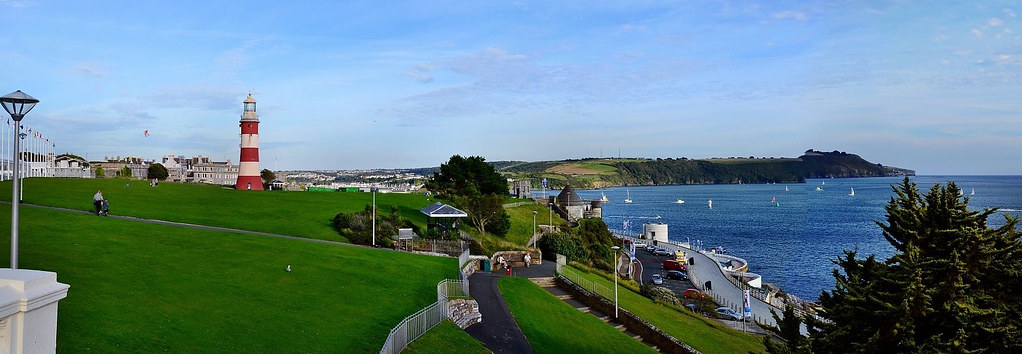
Plymouth city guide. The Hoe Plymouth UK and the view out to sea

Plymouth: Britain’s Ocean City

The Barbican & Sutton Harbour | Plymouth Hoe | National Marine Aquarium | Tinside Lido | The Box | Plymouth Gin Distillery | Cawsand & Whitsand Bay

⚓ Plymouth at a Glance

UK’s first
Urban National
Marine Park
10+
World-Class
Attractions
15 min
To Cornwall’s
Finest Beaches
1–3 Days
Ideal
Visit Length
  • The Barbican & Sutton Harbour — Plymouth’s historic waterfront, the Mayflower Steps, Elizabethan House, independent restaurants, galleries and the city’s oldest streets — FREE to explore
  • Plymouth Hoe — Sir Francis Drake’s famous bowling green, Smeaton’s Tower lighthouse, the Naval War Memorial, panoramic views across Plymouth Sound — FREE
  • National Marine Aquarium — The UK’s largest aquarium, 5,000+ marine animals, a 650,000-litre tropical tank, Britain’s deepest aquarium habitat, all-inclusive annual pass (from £25)
  • Tinside Lido — 1935 Art Deco saltwater pool on the edge of Plymouth Hoe, one of Europe’s ten finest outdoor pools, open May–September (from £10/swim)
  • The Box — Plymouth’s award-winning museum, gallery and archive, shortlisted for Art Fund Museum of the Year 2026 and currently Museum in Residence at Downing Street — FREE admission
  • Plymouth Gin Distillery — The oldest working gin distillery in England (since 1793), in a building dating to 1431, where the Pilgrim Fathers spent their last night. Tours from £15
  • Royal William Yard — Brunel’s masterpiece of Georgian naval engineering, now transformed into Plymouth’s finest destination for restaurants, galleries, and the Cremyll ferry
  • Cawsand Ferry & the Rame Peninsula — 30-minute boat trip from the Barbican to the Cornish villages of Cawsand and Kingsand, gateway to Whitsand Bay beaches (seasonal: April–October)
  • Drake Circus & The Barcode — Plymouth’s main shopping centre and adjacent entertainment complex — cinema, mini-golf, restaurants and Drake Circus itself, one of the best retail destinations in the South West
  • Dartmoor National Park — 30 minutes from Plymouth city centre: tors, moorland, wild ponies, prehistoric sites, Dartmeet and Haytor — FREE to explore

Why Visit Plymouth?

Plymouth rewards visitors who give it time — and it consistently surprises those who assume a ferry port is just somewhere you pass through. Here is why it deserves a full day or more on any itinerary.

⚓ The Barbican — England’s Finest Maritime Quarter

The Barbican is one of the most atmospheric historic waterfronts in England — cobbled lanes, Elizabethan buildings, independent galleries, the Mayflower Steps where the Pilgrim Fathers departed for the New World in 1620, and Sutton Harbour lined with fishing boats and restaurants. Plymouth Gin has been distilled here since 1793, in a building that dates to 1431. No other city of similar size in England wears its maritime history quite so naturally — and almost all of it is free to wander.

🌊 Plymouth Sound — A Marine Park on Your Doorstep

In 2019, Plymouth Sound became the UK’s first National Marine Park — a vast area of coastal water, islands, beaches and headlands recognised as nationally significant for its marine life, history and natural beauty. From the Hoe, the views across the Sound take in Drake’s Island, the Breakwater, and the headlands of Cornwall across the water. The Tinside Lido sits at the Hoe’s edge, its Art Deco curves reflected in the sea below. On a clear day, you can watch ferries to France and warships from Devonport all from the same bench.

🏖️ Cornwall’s Beaches in 15 Minutes

What surprises most visitors is how close Plymouth is to some of Cornwall’s finest beaches. Via the Torpoint Ferry, Cawsand and Kingsand are 15 minutes away. The Cawsand Ferry runs direct from the Barbican in summer — a 30-minute boat trip to two of the most unspoilt Cornish fishing villages in the county. Whitsand Bay — three miles of Atlantic-facing sand and surf — is 20 minutes via Torpoint. You don’t need to travel far into Cornwall for world-class coastal walking, swimming and surfing.

🚢 The Gateway to France

Plymouth is the natural departure point for western Brittany and Finistère — Brittany Ferries sails year-round to Roscoff, arriving on the toll-free roads of western France. For those catching a ferry, the Barbican is a ten-minute walk from Plymouth Millbay terminal — making a morning in the gin distillery or a final lunch on Sutton Harbour a perfectly practical last act before crossing. See our Roscoff town guide for what awaits on the other side.

Top Things to Do in Plymouth

Plymouth’s attractions are spread across several distinct areas — the Barbican and Sutton Harbour waterfront, Plymouth Hoe and the seafront, the city centre, and Royal William Yard to the west. Here is everything worth seeing, with verified 2026 admission prices.

The Barbican & Sutton Harbour

FREE to explore | Location: Barbican Waterfront, Plymouth PL1 2NX | The ferry terminal is 10 minutes’ walk

The Barbican is the historic heart of Plymouth — a compact web of cobbled lanes and medieval streets that survived the Blitz by fortunate geography, preserving buildings that date to the 15th and 16th centuries. Sutton Harbour, the working inner harbour around which the Barbican sits, has been the centre of Plymouth’s maritime life for over 500 years. Today it’s lined with independent restaurants, galleries, and the Barbican Theatre. The Mayflower Steps mark the spot from which the Pilgrim Fathers departed for North America in September 1620 — a small but genuinely moving piece of history at the water’s edge.

The Elizabethan House on New Street is a rare surviving example of a 16th-century merchant’s home — three floors of period rooms showing life in Plymouth during the age of exploration. Check opening times before visiting as hours vary seasonally. The Barbican Botanical Gin Room and the Plymouth Gin Distillery both sit within the Barbican, making this the best area in the city to spend a morning before a sailing.

💡 Ferry tip: If you’re catching an evening sailing to Roscoff, the Barbican is the ideal place to spend your last few hours. The Cawsand Ferry departs from Barbican Landing Stage in the morning and returns in the afternoon — making a combination Barbican morning, Cawsand afternoon, and evening sailing a perfect final day before France.

Plymouth Hoe & Smeaton’s Tower

Hoe: FREE | Smeaton’s Tower: small admission | Location: Hoe Road, Plymouth PL1 2NZ

Plymouth Hoe is the wide, grassy headland above the Sound that has defined the city’s relationship with the sea for centuries. It is where Sir Francis Drake was reportedly playing bowls when the Spanish Armada was sighted in 1588 — whether the story is true or not, the view from here makes it instantly believable. The panorama across Plymouth Sound encompasses Drake’s Island, the Plymouth Breakwater, the Cornish coast to the west, and on a clear day the outline of the Eddystone Reef on the horizon.

Smeaton’s Tower — the distinctive red-and-white striped lighthouse originally built on the Eddystone Reef in 1759 and relocated to the Hoe in 1882 — can be climbed for views from the lantern room. The Naval War Memorial on the Hoe commemorates the sailors of two World Wars. Below the Hoe, Tinside Lido completes the seafront picture — Art Deco poolside swimming with the Sound stretching away behind you.

⚠️ Tombstoning — Do Not Jump Around Plymouth Hoe and the sea walls you may see people jumping from the walls into the sea below — this is called tombstoning. Do not do it. The rocks, currents and hidden underwater hazards around Plymouth Hoe have caused serious injuries, and people have been paralysed tombstoning in this area. There are signs on the walls explicitly warning against it. The sea looks inviting from height; what lies beneath is not visible. If you want to swim, use Tinside Lido or head to one of the fantastic beaches nearby.

National Marine Aquarium

From £25 — includes free annual pass for unlimited return visits | Under-3s FREE | Address: Rope Walk, Coxside, PL4 0LF | Open: Daily | Duration: 2–3 hours minimum

The National Marine Aquarium is the UK’s largest aquarium and the home of the Ocean Conservation Trust — a charity, not a commercial attraction, which means every admission directly supports marine conservation. More than 5,000 marine animals live across its habitats, from the local waters of Plymouth Sound through the Atlantic to the tropical coral reef. The centrepiece is the 650,000-litre Atlantic Ocean habitat — Britain’s largest aquarium tank with an 8-metre viewing window — where sharks, rays, and a famously mischievous loggerhead turtle called Friday circle in a display that genuinely stops people in their tracks.

Walking sharks arrived in late 2025 — a new species for the NMA. Ocean Discovery Rangers run daily feeding sessions and talks. The Waves Café overlooks Plymouth Sound with panoramic views of the Barbican. Every admission ticket comes with a free annual pass — excellent value if you’re staying in the area. Always check the official website at national-aquarium.co.uk before visiting as prices are updated regularly.

Tinside Lido

From £10/swim (visitors) | £6.30 (Plymouth residents) | Open: 23 May–September 2026 | Location: Hoe Road, PL1 3DE | Coffee pod open year-round

Built in 1935 and Grade II listed, Tinside Lido is an Art Deco masterpiece that sits at the very edge of Plymouth Hoe, its semicircular pools cantilevered above the Sound. It is consistently voted one of the ten finest outdoor pools in Europe — and it earns that description. The water is saltwater from Plymouth Sound, crystal clear, and framed by the same panoramic bay views that have made the Hoe famous for centuries. A sun deck wraps the main pool; the views during an evening swim as the ferries head out across the Sound are extraordinary.

Book in advance at tinsidelido.co.uk — the lido operates a session booking system and sells out quickly on warm summer days. The 2026 season runs a full programme of events including Murder Mystery evenings, live music nights, and poolside viewing for the British Firework Championships on 12 and 13 August. The coffee pod at the sun terrace is open year-round even when swimming is out of season.

The Box — Plymouth’s Award-Winning Museum & Gallery

FREE admission | Address: Tavistock Place, PL4 8AX | Open: Tue–Sun | Note: Book a free ticket in advance for major exhibitions

The Box opened in 2020 as Plymouth’s flagship museum, gallery and archive — combining what were previously five separate institutions under one spectacular roof. In 2026 it has been shortlisted for the Art Fund Museum of the Year, and it has been selected as Museum in Residence at 10 Downing Street — bringing Plymouth’s collections to world leaders and government visitors throughout the year. Fourteen restored 19th-century ship’s figureheads hang in the main atrium as a “sail” of carved wooden faces: it is one of the most arresting museum entrances in the South West.

The permanent collection spans two million objects: maritime art, natural history, archaeology, fine art including works by Joshua Reynolds (born locally in Plympton), the Newlyn and St Ives schools, and the largest collection of Plymouth porcelain in the UK. Spring 2026 exhibitions include Beryl Cook: Pride and Joy (24 January–31 May, free) and Journeys with Mai (14 February–14 June, free). Autumn 2026 will include a national tour of Steve McQueen’s Grenfell film. Book free tickets in advance for major exhibitions at theboxplymouth.com.

Plymouth Gin Distillery — Black Friars

Standard Tour £15 | Connoisseur Tour £20 | Master Distiller’s Tour £40 | Address: 60 Southside Street, The Barbican, PL1 2LQ | Open: Mon–Sat 10am–5pm; Sun 11am–5pm

Black Friars Distillery is the oldest working gin distillery in England. It has been producing Plymouth Gin to the same recipe since 1793, in a building whose oldest section — the Refectory, a medieval hall with a remarkable hull-shaped timber roof — dates from 1431. Before it became a distillery it served as a Dominican friary, a debtors’ prison, a meeting house, and — most famously — as the lodging of the Pilgrim Fathers on their last night in England before the Mayflower set sail in 1620. The cocktail bar in the Refectory, where the Pilgrims reportedly drank and prayed before departure, is now arguably the most atmospheric gin bar in the UK.

The Standard Tour (around 1 hour, £15) covers the history, the botanicals, and a tutored tasting. The Master Distiller’s Tour (2.5 hours, £40) includes creating and taking home your own bespoke gin. Each tour includes a gin and tonic or a miniature to take away. Evening group tours are available by appointment. Book online or on arrival from the Barbican entrance on Southside Street.

Royal William Yard

FREE to explore | Location: Royal William Yard, Stonehouse, PL1 3RP | 10 min walk from Millbay ferry terminal

Royal William Yard is one of the finest examples of Georgian naval architecture in Europe — a vast self-contained victualling complex designed by the engineer John Rennie and built between 1826 and 1835 to supply the Royal Navy. Its granite warehouses, brewhouses, bakeries and cooperages have been converted into Plymouth’s most distinctive destination: independent restaurants, a cinema (Everyman), art galleries, the Barbican Kitchen, breweries, and a weekend market. The Cremyll Ferry to Mount Edgcumbe and the Rame Peninsula departs from Royal William Yard Marina every 30 minutes. For anyone sailing to Roscoff from Millbay — a 10-minute walk away — RWY makes an excellent final lunch stop.

🛍️ Drake Circus

Plymouth’s main covered shopping centre — over 70 stores including major fashion and retail brands, plus 15 cafés, bars and restaurants. Centrally located and a good base if you’re planning to explore the city on foot, as The Box, the Barbican and Plymouth Hoe are all within easy walking distance.

Parking: 1,270 spaces, cashless (card/Apple Pay only), open Mon–Sat 07:00–23:00, Sun 08:00–23:00. Tariff: up to 2 hrs £3.50 | 2–3 hrs £4.50 | 3–4 hrs £5.50 | 4–5 hrs £6.30 | 5–6 hrs £7.30 | 6–24 hrs £15. Evening rate: £6 if arriving after 17:00; overnight £7 (arrive after 17:00, leave before 10:00). Pay on exit. Because it’s central and pay-on-exit, it’s a practical choice if you want to park once and walk to multiple areas of the city.

🎳 Barbican Leisure Park

Plymouth’s go-to entertainment complex near the waterfront. Barbican Leisure Park brings together Vue Cinema, Tenpin bowling, Nando’s, Pizza Express, Pizza Hut, Frankie & Benny’s, Fry’s Grillhouse, and Nuffield Health gym all in one place. A reliable option for a rainy afternoon, a family evening, or a group meal before the ferry. See the full list of venues at barbican-leisure.co.uk.

Parking: Free on site — but it is managed parking for Barbican Leisure customers only. If you park here and wander off to the Barbican waterfront or elsewhere in the city, you risk a fine. It’s best used if you’re spending your time at the leisure park itself.

🎮 The Barcode

Adjacent to Drake Circus, The Barcode is Plymouth’s entertainment destination — mini-golf, a cinema, additional restaurants and bars, and a range of leisure activities. It sits alongside Drake Circus and shares the same car park, so the two work well together. Between The Barcode and Barbican Leisure Park you have everything covered — mini-golf and cinema at The Barcode, bowling and more cinema at Barbican Leisure, escape rooms nearby, and restaurants across all three venues.

Parking: The Barcode has its own separate car park with 400+ spaces — same cashless system and same tariff as Drake Circus (up to 2hrs £3.50, rising to £15 for 6–24hrs; evening rate £6 after 17:00). Pay on exit. The Barcode car park sits slightly closer to the Barbican than Drake Circus, making it a particularly good option if you want to park centrally and walk down to the waterfront, Sutton Harbour and the Barbican.

🔐 Escape Rooms

Plymouth has two well-regarded escape room venues. Escape Plymouth is on Royal Parade in the city centre, with multiple themed rooms and strong reviews for puzzle quality and production. Escapism Plymouth is near The Barcode and the Barbican — different rooms, equally good reputation. Both suit a group evening before the ferry or a rainy afternoon. Book online in advance as popular slots fill quickly.

⛵ Plymouth Harbour Cruises

Plymouth Boat Trips operates a range of sightseeing cruises from the Barbican Landing Stage — naval harbour tours past Devonport Dockyard (the largest naval base in Western Europe), Drake’s Island cruises, and Sound trips. A harbour cruise is one of the best ways to understand Plymouth’s geography and the sheer scale of Plymouth Sound. The tour commentary covers Drake, the Armada, Brunel’s Royal William Yard, and modern naval operations.

🏰 The Royal Citadel

One of the most extraordinary buildings in Plymouth, and one most visitors walk straight past. The Royal Citadel is a vast 17th-century military fortress built by Charles II from 1665, occupying the eastern end of Plymouth Hoe with 70-foot limestone walls and a spectacular Baroque entrance gate. It is still an active military base — home to 29 Commando Regiment Royal Artillery — which means the only way in is by guided tour, operated by Armada Tours on behalf of English Heritage. Tours run every Saturday, April–September 2026, departing 14:00. Arrive by 14:00 sharp at the Commando Memorial on Lambhay Hill — late arrivals cannot join. Bring photo ID; bags are searched; no photography permitted inside. Book in advance via Eventbrite. Allow 2 hours. The rampart views across Plymouth Sound alone are worth it.

🏄 Water Sports — Mount Batten Centre

Plymouth Sound is one of the finest natural sailing and water sports venues in the UK — a sheltered, deep-water bay with reliable winds and easy access. The Mount Batten Centre on the eastern shore of the Sound offers sailing, windsurfing, kayaking, stand-up paddleboarding, and powerboating for all abilities. Reachable by the Mount Batten Ferry from the Barbican (£1.50 each way, every 30 minutes, summer service 08:00–22:00 from 1 May). The centre also runs taster sessions and courses for complete beginners. See mountbattencentre.com for full activity listings and booking.

🎭 Theatre & Live Music

The Theatre Royal Plymouth is one of the largest provincial theatres in England — producing and touring major productions, and hosting national touring shows throughout the year. The Barbican Theatre is Plymouth’s independent theatre, focused on new work and community productions. The British Firework Championships on 12 and 13 August are Plymouth’s signature annual event — competing firework displays launched from barges in the Sound, viewed from the Hoe (free) or from Tinside Lido (ticketed events).
Sample Plymouth Itineraries

Whether you have a morning before your ferry or a full weekend, Plymouth rewards planning. Here are suggested itineraries for different visit lengths.

Morning Before the Ferry: Best of the Barbican

If you’re catching an evening overnight sailing, the Barbican is perfectly positioned. Walk the cobbled lanes, visit the Mayflower Steps, browse the independent galleries, and have a Barbican gin tour at the Plymouth Gin Distillery (tours run from mid-morning, pre-book). Lunch on Sutton Harbour — the Rockfish on the quayside does exceptional fish and chips. Millbay terminal is a 10-minute walk west from the Barbican waterfront. Allow 3–4 hours from arrival.

One Full Day: The Essential Plymouth

Morning: Start at the National Marine Aquarium (open from 10am) — allow 2–3 hours. The tropical shark tank and Ocean Discovery Rangers talks are the highlights. Walk along the Barbican waterfront to Sutton Harbour for coffee.

Afternoon: Walk up to Plymouth Hoe — Drake’s statue, the Naval War Memorial, and the view across the Sound. If it’s May–September, book a session at Tinside Lido for a swim (pre-book online). Walk east along the seafront.

Late afternoon/evening: Return through the Barbican for dinner — Rockfish or the Barbican Kitchen are the standout options. End with a gin in the Refectory at Black Friars.

Two Days: Plymouth & the Cawsand Ferry

Day 1 — The City: The Box in the morning (free, open Tue–Sun — book for Beryl Cook exhibition). Lunch at The Box Kitchen & Bar. Afternoon at Royal William Yard — walk around the Georgian courtyard, visit Everyman Cinema or the galleries. Dinner at RWY’s waterfront restaurants. Optional: harbour cruise from the Barbican in the late afternoon.

Day 2 — The Cawsand Ferry: Take the 09:00 Cawsand Ferry from Barbican Landing Stage (seasonal, 1 April–31 October). 30-minute crossing to Cawsand. Spend the morning exploring the twin villages of Cawsand and Kingsand — beaches, pubs, walks along Rame Head. Return on the 14:00 ferry. Afternoon: Barbican and Gin Distillery tour before an evening sailing to Roscoff.

Where to Eat in Plymouth

Plymouth’s food scene is centred on the Barbican and Sutton Harbour, with excellent options at Royal William Yard and a growing independent scene in the city centre. Seafood — caught locally in Plymouth Sound and brought in through Sutton Harbour fish market — is the local speciality.

What to Eat in Plymouth

Seafood — locally caught fish and shellfish, particularly from the Barbican and Sutton Harbour. Rockfish on the quayside is Plymouth’s most acclaimed seafood restaurant. Pasties and cream teas — Devon and Cornwall’s competing traditions are both within reach; both are excellent. Gin cocktails — Plymouth Gin’s Refectory bar at Black Friars Distillery is a genuine destination. Fish and chips — best on the Barbican waterfront or at the Hoe, eaten outside with the Sound behind you.

Rockfish, Sutton Harbour

Plymouth’s most celebrated seafood restaurant, operated by chef Mitch Tonks, whose name has become synonymous with Plymouth’s food revival. Overlooking Sutton Harbour directly on the water, Rockfish focuses on fresh day-boat fish — the menu changes with the catch. Book in advance. Address: 3 Rope Walk, Barbican, PL4 0LF.

Barbican Kitchen, Royal William Yard

A consistently excellent brasserie in the Grade I listed brewery building at Royal William Yard. The cooking here from the Tanner brothers elevated Plymouth’s restaurant scene significantly and the waterfront location at RWY is one of the finest dining settings in the city. Seasonal menus, strong South West sourcing. Address: Royal William Yard, PL1 3GD.

The Refectory Bar, Black Friars

Plymouth Gin’s cocktail bar occupies the medieval Refectory Hall at Black Friars Distillery — a magnificent timber-roofed room where the Pilgrim Fathers supposedly spent their last night in 1620. It is one of the most atmospheric drinking venues in the South West. Plymouth Gin cocktails are, unsurprisingly, excellent. Address: 60 Southside Street, PL1 2LQ.

The Box Kitchen & Bar

Plymouth’s most interesting museum café — locally inspired seasonal menus served in the Edwardian building that houses The Box’s permanent collections. A good choice for breakfast or lunch if you’re spending time at the museum. Good coffee, relaxed pace, worth visiting even without a ticket. Address: Tavistock Place, PL4 8AX.

Waves Café, National Marine Aquarium

Located within the NMA and open to all visitors, Waves serves hot food and light meals with spectacular harbour views towards the Barbican. Convenient for combining with an aquarium visit. The views across Sutton Harbour are some of the best in the city from an indoor setting.

Barbican Leisure Park — Multiple Restaurants

Barbican Leisure Park consolidates a broad range of chain restaurants in one place near the waterfront — Nando’s, Pizza Express, Pizza Hut, Frankie & Benny’s, and Fry’s Grillhouse all sit alongside Vue Cinema and Tenpin bowling. It’s the most practical option for groups or families wanting a reliable, no-planning-required meal, particularly in the evening before an overnight ferry. Free parking on site for Barbican Leisure customers.

The Barbican Waterfront

The Barbican and Sutton Harbour are lined with independent restaurants and cafés covering seafood, wood-fired pizza, tapas, and the essential Cornish pasty. The Friday Fish Market on the quayside draws both locals and visitors for fresh daily catches sold direct. Worth a walk along the entire harbourfront before settling on a spot.

Things to Do Near Plymouth — Beaches, Ferries & Day Trips

Plymouth’s position at the meeting point of Devon and Cornwall means some outstanding day trips and half-day excursions are within very easy reach — including some of Cornwall’s finest beaches, which most visitors don’t realise are only 15–20 minutes away.

⛴️ The Cawsand Ferry — Barbican to the Rame Peninsula

Seasonal: 1 April – 31 October 2026 | Departs Barbican Landing Stage: 09:00, 10:30, 12:00, 13:30, 15:00, 16:30 | Returns from Cawsand: 09:30, 11:00, 12:30, 14:00, 15:30, 17:00

The Cawsand Ferry is Plymouth’s finest short excursion — a 30-minute crossing from the Barbican Landing Stage across Plymouth Sound to the Cornish villages of Cawsand and Kingsand on the Rame Peninsula. The boat trip itself is a pleasure: you leave Sutton Harbour, pass under the Plymouth Breakwater, cross the Sound, and arrive at one of Cornwall’s most unspoilt corners. The twin villages of Cawsand and Kingsand sit side by side on a sheltered bay, divided by what was once the county boundary between Devon and Cornwall — one street is still marked by the old boundary stone.

Both villages have sandy beaches, excellent pubs and cafés, and access to the South West Coast Path running to Rame Head — one of the finest short coastal walks in the region. The walk from Kingsand to Rame Head along the clifftops takes about an hour each way and is exceptional. Take the morning ferry, walk to Rame Head and back, have lunch at the Rising Sun in Kingsand, and return on the 14:00 or 15:30 ferry. Operated by Plymouth Boat Trips. Check plymouthboattrips.co.uk for fares and any service updates.

⛴️ Mount Batten Ferry — Beaches & Water Sports on the East Side of the Sound

Ferry from Barbican Landing Stage: £1.50 adults | 50p children | Every 30 min | Summer (Fri 1 May–Sun 27 Sept 2026): Mon–Fri 08:00–22:00, Sat–Sun 09:00–22:00 | Departs Barbican at quarter past and quarter to the hour; departs Mount Batten on the hour and half hour

The Mount Batten Ferry is one of Plymouth’s most underused gems — a 5-minute crossing from the Barbican Landing Stage to the Mount Batten peninsula on the eastern shore of Plymouth Sound, with free parking at the Mount Batten end. The ferry runs year-round (363 days) and is fully electric — MV Copper was converted in 2021 as part of Plymouth’s air quality strategy. In summer the service runs until 22:00, making it suitable for an evening return after a day’s walking or watersports. Note: the service currently departs from the Mount Batten Centre Pontoon (not the original landing stage, which is undergoing permanent works) — check mountbattenferry.co.uk for any updates before travelling.

Mount Batten Watersports Centre sits right at the landing point — one of the finest outdoor water sports facilities in the South West, offering sailing, windsurfing, kayaking, stand-up paddleboarding, and powerboating for all abilities and ages. Taster sessions are available for complete beginners. Full activity listings and booking at mountbattencentre.com.

Jennycliff & Bovisand beaches are accessible on foot from Mount Batten along the South West Coast Path — Jennycliff about 30 minutes’ walk south, with panoramic views back across the Sound to the Hoe and Tinside Lido. The coastal path from Mount Batten to Wembury runs through some of the finest coastal scenery in South Devon, and the ferry makes it possible to create a circular day without a car: ferry out, walk south, bus back.

🚶 Plymouth to Wembury — South West Coast Path

Distance: ~10 miles (17km) | Return: bus 48 from Wembury (~33 min) | Start: Mount Batten Ferry from the Barbican

Plymouth is the only city in the UK that the South West Coast Path passes through — and the stretch south-east from Plymouth to Wembury is one of the finest coastal walks in Devon. Take the Mount Batten Ferry from the Barbican, then head south along the Coast Path past Jennycliff and its beaches, around the headland at Bovisand, and along the dramatic clifftop to Wembury. The views back across Plymouth Sound from Jennycliff are spectacular. Wembury beach itself is a quiet, sheltered National Trust beach with a seasonal café and rock pools at low tide. Walk south to the River Yealm for even more unspoilt estuary scenery if time allows.

Return by bus 48 from Wembury to Plymouth city centre (approximately 33 minutes). This makes an excellent full-day walk requiring no car — ferry out in the morning, lunch at Wembury, bus back in the afternoon.

🎬 Mount Edgcumbe, the Cremyll Ferry & the Orangery — As Seen in Beyond Paradise

Cremyll Ferry from Royal William Yard: year-round, every 30 min, 8-min crossing

Mount Edgcumbe Country Park and House is one of the finest estate landscapes in the South West — 800 acres of coastal woodland, formal gardens, cliff-top walks, and sweeping views across Plymouth Sound. The Cremyll Ferry from Royal William Yard delivers you directly into the grounds in 8 minutes. If this scenery looks familiar, you may have seen it on screen: Mount Edgcumbe — along with Kingsand, Cawsand, Cremyll and the surrounding Rame Peninsula — has been a recurring filming location for the BBC series Beyond Paradise, the spin-off from Death in Paradise, which uses the Devon and Cornwall coast as its backdrop. Several cast members have spoken publicly about filming at Mount Edgcumbe.

The formal gardens include the national camellia collection, a French garden, an Italian garden, and an English garden laid out across the clifftop with sea views. The Orangery — a beautifully restored 18th-century structure in the gardens — serves food and refreshments and is one of the most atmospheric places for lunch within easy reach of Plymouth.

The walk from Cremyll through the park to Kingsand takes around 1.5 hours along the Coast Path through outstanding scenery. Mount Edgcumbe House itself is open on selected days — check mountedgcumbe.gov.uk before visiting. The park and gardens are free to access year-round. Take the Cremyll Ferry from Royal William Yard Marina (operating from RWY while Admirals Hard slipway is under repair — check plymouthboattrips.co.uk for current departures).

Year-round | Every 30 min | 8-minute crossing | Departs Royal William Yard Marina

One of Plymouth’s oldest and most loved ferry crossings, the Cremyll Ferry has been carrying passengers across the River Tamar since the 13th century. The 8-minute trip from Royal William Yard to Cremyll Quay delivers you directly into the grounds of Mount Edgcumbe Country Park — 800 acres of coastal woodland, formal gardens (including the national camellia collection), clifftop walks to Kingsand and Cawsand, and panoramic views back across the Sound to Plymouth. Mount Edgcumbe house and the park’s gardens are among the finest in the South West. The walk from Cremyll through the park to Kingsand takes around 1.5 hours. Operated by Plymouth Boat Trips from Royal William Yard Marina (Admirals Hard slipway currently closed for repair — check plymouthboattrips.co.uk before travelling).

🏖️ Beaches Near Plymouth — Cornwall in 15 Minutes

One of Plymouth’s best-kept secrets among visitors is how close the Cornish beaches are. Via the Torpoint Ferry (runs continuously, 10-minute crossing, toll applies), you are in Cornwall within minutes — and some of the finest beaches in the county are a short drive further south.

Cawsand & Kingsand Beaches

~15 min via Torpoint Ferry or 30 min by Cawsand Ferry. Sheltered east-facing shingle and sand beaches tucked inside the Rame Peninsula, with views across Plymouth Sound. Family-friendly, calm water, good for swimming. Dogs allowed year-round on Kingsand Beach. Excellent pubs and cafés in both villages.

Tregonhawke Beach, Whitsand Bay

~20 min via Torpoint Ferry. The most accessible section of Whitsand Bay — a long, Atlantic-facing strand of golden sand beneath dramatic cliffs. RNLI lifeguards patrol in season. Steep cliff-path access (5-min descent). Strong rip currents — always swim between flags. Surfers and divers use the bay year-round.

Freathy Beach, Whitsand Bay

~25 min via Torpoint Ferry. A quieter section of Whitsand Bay where the cliff-top chalets of the Freathy holiday community cling to the hillside above the beach. Steep access path, no facilities on the beach itself, but one of the most spectacular settings on the bay. Dogs allowed year-round. Great for walkers using the South West Coast Path.

Tregantle (Long Sands), Whitsand Bay

~25 min via Torpoint Ferry. The western end of Whitsand Bay beneath Tregantle Fort, still used by the Ministry of Defence (beach access restricted during firing range operations — check before visiting). On open days, Long Sands is a magnificent sweep of sand with reliable surf and very few people. One of the least crowded beaches in Cornwall.

Rame Head

~20 min via Torpoint Ferry. Not a beach but one of the finest headlands in Cornwall — a dramatic promontory with a ruined 14th-century chapel at its tip, cliffs plunging to the sea, and panoramic views from Plymouth Sound east to the Lizard. Walk from Cawsand or drive to the small car park above Rame village. Part of the Cornwall Area of Outstanding Natural Beauty.

💡 Torpoint Ferry — what you actually pay: The toll is collected in one direction only — Torpoint to Plymouth (Cornwall to Devon). You pay on the way back, not going out. Standard car (under 3.5t): £3.00 cash/card or £1.50 with a TamarTag. Motorcycles are tolled in the opposite direction (Plymouth to Torpoint). Foot passengers and cyclists travel free. The ferry runs 24 hours, 7 days a week. For the Cawsand and Whitsand beaches on foot, the free Cawsand Ferry from the Barbican is a simpler option in summer — no driving, no parking, just a 30-minute boat trip direct to Cawsand. See tamarcrossings.org.uk for current vehicle tariffs and TamarTag information.

🌿 Dartmoor National Park

30 minutes north of Plymouth, Dartmoor is England’s southernmost National Park — high moorland, ancient granite tors, Bronze Age settlements, and the famous Dartmoor ponies. Haytor is the most visited tor, accessible from the B3387. Dartmeet at the confluence of the East and West Dart rivers is a perfect picnic spot. Princetown (at over 1,400 feet) is the highest town in England and the location of Dartmoor Prison. Entirely free to access with multiple car parks throughout the park.

🏰 Saltram House (National Trust)

A magnificent Georgian mansion on the eastern edge of Plymouth, Saltram was the home of the Parker family and is one of the finest National Trust properties in Devon. Joshua Reynolds — born in nearby Plympton — painted here. The house retains original Adam interiors, outstanding collections, and grounds stretching down to the River Plym. Admission charged (NT members free). About 20 minutes from the city centre via the A379.

🚢 Heading to Roscoff

Brittany Ferries sails year-round from Plymouth Millbay to Roscoff — arriving at the gateway to western Brittany and the toll-free roads of Finistère. The ferry terminal at Millbay is a 10-minute walk from the Barbican. See our Plymouth to Roscoff travel guide for everything about the crossing, the journey to Plymouth from across the UK, and what awaits in Brittany.

Practical Information for Visiting Plymouth

Plymouth’s main attractions are clustered in three walkable areas: the Barbican and Sutton Harbour, Plymouth Hoe and the seafront, and Royal William Yard. Here is everything you need to plan your visit.

Getting to Plymouth

By car: The A38 (Devon Expressway) brings drivers from Exeter and Cornwall directly to Plymouth with good signposting for the Barbican and ferry terminal. From Wales and the Midlands, the M5 south connects to the A38. Sat nav postcode for the Barbican: PL4 0DW. For the ferry terminal: PL1 3EW (what3words: ///divide.brick.exam).

By train: GWR runs direct services from London Paddington (3–3.5 hrs), Bristol Parkway (1.5 hrs), Exeter (50 min), Cardiff (2h 15 min), and Truro (1 hr). Plymouth station is approximately 30–35 minutes’ walk from the ferry terminal at Millbay, or a 5–7 minute taxi ride (approx. £7–9). No direct bus runs between the station and the port. Coypool Park & Ride (PL7 4TB) offers free 24-hour parking on Plymouth’s eastern edge for those arriving by car and wanting to avoid city centre parking. The Night Riviera sleeper departs London Paddington around midnight and arrives at Plymouth at 05:22 — useful for those catching a daytime sailing.

By ferry from France: Brittany Ferries sails year-round from Roscoff (Finistère) to Plymouth Millbay. Daytime sailing arrives Plymouth approximately 19:00. Overnight sailing arrives 08:00–10:15 (arrival varies by up to 1 hour due to tidal conditions at Roscoff — unique to this route). The terminal at Millbay is 10 minutes’ walk from the Barbican — making the waterfront an easy first stop after disembarking.

Parking in Plymouth

Barbican & Sutton Harbour: Sutton Harbour car parks (payable) are the most convenient for the Barbican waterfront. Vauxhall Street and Lockyers Quay offer the closest parking to the Barbican restaurants and gin distillery.

Drake Circus: The Drake Circus multi-storey is the most central car park for the city centre and The Box — 1,270 spaces, cashless, open Mon–Sat 07:00–23:00, Sun 08:00–23:00. Tariff: up to 2hrs £3.50 | 3hrs £4.50 | 4hrs £5.50 | 5hrs £6.30 | 6hrs £7.30 | 6–24hrs £15. Evening rate £6 after 17:00. Pay on exit — a good option for parking once and exploring the city on foot.

The Barcode: The Barcode has its own separate car park with 400+ spaces, same cashless system and same tariff as Drake Circus above. It sits slightly closer to the Barbican than Drake Circus, making it the better option if you want to park centrally and walk down to the waterfront, Sutton Harbour and the Barbican restaurants.

Plymouth Hoe: Pay-and-display parking on Hoe Road and Cliff Road runs directly along the seafront above Tinside Lido — convenient but limited, and fills early in summer. Madeira Road car park below the Hoe is a short walk from the lido.

Coypool Park & Ride: PL7 4TB — free, 24 hours. Positioned on the eastern approach to Plymouth. Take a taxi or cycle from here to the city centre if needed.

Best Time to Visit Plymouth

May–September: Best for Tinside Lido (open from 23 May), the Cawsand Ferry (1 April–31 October), Whitsand Bay beaches, and the British Firework Championships (12–13 August). The National Marine Aquarium, The Box, and all city centre attractions are open year-round. Summer weekends on the Hoe are busy; weekday mornings are quieter at the aquarium and The Box.

October–April: The Box, NMA, Gin Distillery, Royal William Yard and the Barbican are all open throughout the year. Tinside Lido is closed for swimming (the coffee pod and sun terrace remain open year-round). The Cawsand Ferry closes from November until April — Cremyll Ferry runs year-round as the alternative. Autumn and winter weekdays are quieter and a good time to visit the NMA and The Box without summer crowds.

Plymouth City Guide: Frequently Asked Questions

Everything visitors most commonly ask about Plymouth — answered with verified 2026 information.

Is Plymouth worth visiting?

Absolutely — Plymouth is one of the most underrated cities in England and consistently surprises visitors who expect a ferry port and find an extraordinary maritime city instead. The Barbican is one of England’s finest historic waterfronts. Plymouth Hoe is genuinely dramatic. The National Marine Aquarium is the UK’s largest. The Box is free, excellent, and in 2026 shortlisted for Art Fund Museum of the Year. Tinside Lido is among Europe’s best outdoor pools. And within 15 minutes via the Torpoint Ferry, you’re on some of Cornwall’s finest beaches. Plymouth rewards a full day’s exploration — and more.

What is the best thing to do in Plymouth?

For first-time visitors, the Barbican and Sutton Harbour are the essential start: the Mayflower Steps, the Plymouth Gin Distillery, the independent restaurants and galleries, and the sense of a working harbour that has always faced outward to the sea. Combine with Plymouth Hoe and the view across the Sound for an afternoon. If you have a full day, add the National Marine Aquarium in the morning. If the season is right, the Cawsand Ferry for a trip across to the Rame Peninsula makes for an exceptional day out that very few visitors know exists.

How much does the National Marine Aquarium cost in 2026?

Tickets start from £25 and include a free annual pass for unlimited return visits — excellent value if you plan more than one visit. Under-3s are always free. The NMA is run by the Ocean Conservation Trust (a charity), so admission directly supports marine conservation and education. Always check the current prices at national-aquarium.co.uk before visiting as pricing is updated regularly.

Is there a beach near Plymouth?

Yes — several excellent ones, and they are much closer than most visitors realise. Cawsand and Kingsand beaches are approximately 15 minutes from Plymouth via the Torpoint Ferry — two sheltered, sandy Cornish beaches in unspoilt fishing villages. Whitsand Bay — a three-mile stretch of Atlantic-facing sand — is about 20 minutes via Torpoint. In summer, the Cawsand Ferry from the Barbican Landing Stage runs direct to Cawsand in 30 minutes, making it possible to combine a morning in the Barbican with an afternoon on a Cornish beach.

When does Tinside Lido open in 2026?

Tinside Lido opens for swimming on Saturday 23 May 2026 and runs through to September. Admission from £10 per swim for visitors (£6.30 for Plymouth residents). Book in advance at tinsidelido.co.uk as sessions sell out quickly on warm days. The coffee pod and sun terrace at the lido are open all year round, even when the pool is closed for the winter season.

What is the Cawsand Ferry and when does it run?

The Cawsand Ferry is a seasonal passenger boat service running from the Barbican Landing Stage in Plymouth to the Cornish village of Cawsand on the Rame Peninsula — a 30-minute crossing across Plymouth Sound. It operates from 1 April to 31 October 2026. In 2026, departures run at 09:00, 10:30, 12:00, 13:30, 15:00 and 16:30 from Plymouth; returns from Cawsand at 09:30, 11:00, 12:30, 14:00, 15:30 and 17:00. Operated by Plymouth Boat Trips — check plymouthboattrips.co.uk for fares and updates.

How far is Plymouth from Dartmoor?

Dartmoor National Park is approximately 30 minutes from Plymouth city centre by car — the nearest moorland is much closer. Burrator Reservoir and Dartmeet are around 30 minutes. Haytor, one of the most popular tors, is about 40 minutes. Princetown, the highest town on the moor, is 35 minutes. Dartmoor is free to access at all its main car parks and entry points.

Can you sail to France from Plymouth?

Yes — Brittany Ferries sails year-round from Plymouth Millbay to Roscoff in Finistère, western Brittany. The daytime sailing (selected Fridays) takes approximately 5h 15 min to 6.5 hours. The overnight crossing (most nights) takes 8–11 hours, arriving Roscoff 08:00–10:15. The ferry terminal at Millbay is a 10-minute walk from the Barbican — making the Barbican a perfect final stop before boarding. See our complete Plymouth to Roscoff travel guide for everything about the crossing and what to do when you arrive in Brittany.

Plan Your Plymouth to Roscoff Crossing

Ferry Information

Timetables, ships, cabins, facilities and check-in for the Plymouth to Roscoff crossing

Ferry Guide →

🗺️

Travel Guide

How to board the ferry depending on your type of transport. Car, Motorhome, Motorbike, Foot passengers, Cycling, Accessible travel, Pet Guides and more.

Travel Guides →

🇫🇷

Roscoff Town Guide

What to see and do in Roscoff and Finistère — the old town, Île de Batz, and Brittany’s best roads

Roscoff Guide →

🏍️

Motorbike Touring Guide

Riding in France from Roscoff — rules, mandatory kit, lane filtering, and the best Breton roads

Riding in France Guide →

Ready to Discover Plymouth?

Plymouth is a city that earns its reputation as Britain’s Ocean City. Walk the cobbled lanes of the Barbican where the Pilgrim Fathers began their voyage to the New World. Stand on Plymouth Hoe as Drake stood before you, with the Sound spreading south towards France. Swim in a 1935 Art Deco saltwater lido at the edge of the sea. Take the Cawsand Ferry to a Cornish fishing village most visitors never find. Explore a free world-class museum shortlisted for the UK’s greatest museum prize. And then — when the evening comes — walk ten minutes west to Millbay and board a ferry to Roscoff.

With this complete Plymouth city guide, you have everything you need: the Barbican and Gin Distillery, Plymouth Hoe and Tinside Lido, the National Marine Aquarium, The Box, Royal William Yard, Drake Circus and The Barcode, the Cawsand Ferry, Whitsand Bay, Dartmoor, and all the practical detail for parking, getting around and catching the ferry to France — all verified for 2026. Britain’s Ocean City is waiting.

Ready to Book Your Ferry to Roscoff?

Whether you’re spending a morning in the Barbican or a full day exploring Plymouth and the Cawsand Peninsula — Millbay terminal is just minutes away. Book early for summer sailings and the peak Pont-Aven Friday crossing.

Book Plymouth to Roscoff with Brittany Ferries →

Safe travels, and may Plymouth exceed every expectation.