Affiliate Disclosure: This site contains affiliate links. If you book through these links we may earn a small commission, at no extra cost to you.
Morlaix Day Trip from Roscoff: Complete 2026 Guide
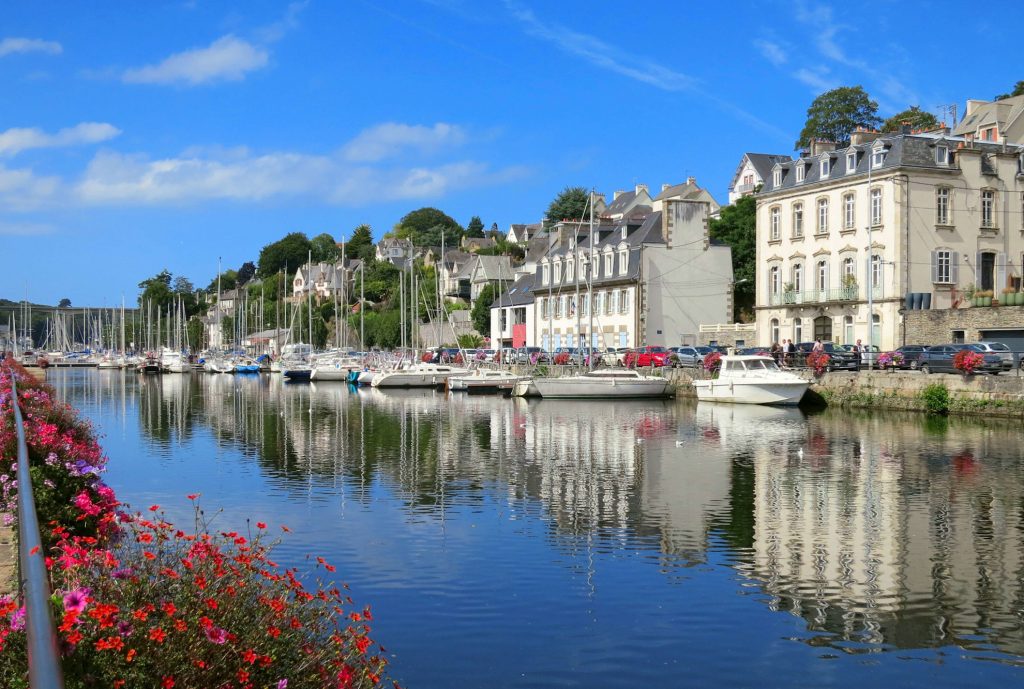
A Morlaix day trip from Roscoff is the most important cultural excursion from the Plymouth to Roscoff ferry port — and at just 30 kilometres south on the toll-free D58, it is within easy reach whether you have arrived by car, on a motorbike, or on the BreizhGo bus. Morlaix is a medieval town built on three hills above the confluence of two rivers, and its defining feature is the two-storey railway viaduct that straddles the old town at 62 metres: one of the great pieces of 19th-century engineering in France, built between 1861 and 1864 to carry the Brest–Paris line, illuminated red at night. Standing beneath it in the Place des Otages is the best introduction to any town in Finistère.
Below the viaduct lies one of the finest concentrations of 16th-century half-timbered architecture in northern France. Morlaix’s 152 surviving medieval houses include the Duchess Anne’s House and the Maison à Pondalez — extraordinary examples of the maison à pondalez, a house type unique to Morlaix in which the interior rises through three floors around a covered courtyard, a monumental granite fireplace, and a single carved oak spiral staircase. These houses were built by linen merchants at the height of Morlaix’s prosperity as the biggest port in Brittany, and they remain the most tangible evidence of that extraordinary wealth. Cobbled alleys lead up the hillsides behind them to viewpoints that look out over rooftops, gardens, and the viaduct’s soaring arches.
This complete Morlaix day trip guide for 2026 covers everything: verified driving directions and the BreizhGo bus from Roscoff, the viaduct walk (free), Duchess Anne’s House with 2026 admission prices and hours, the Maison à Pondalez museum (and its important 2026 note about the Jacobins closure), the Saturday market, the best viewpoints, where to find kig ha farz — Morlaix’s signature dish — and how to extend your day to Saint-Thégonnec, the finest parish close in Brittany, just 12 kilometres south.
Last updated: May 2026 | All admission prices, opening times and transport details verified from official sources
Morlaix: Under the Viaduct
35 min from Roscoff | 62m Viaduct | 152 Half-Timbered Houses | Duchess Anne’s House €3 | Maison à Pondalez Museum | Saturday Market | Kig ha Farz
✅The Viaduct — walk the lower level during daylight for views over the old town and port, completely FREE. Illuminated red after dark — unforgettable from the quayside below
✅Duchess Anne’s House — a lantern house built c.1525, with an 11-metre carved oak spiral staircase rising through a covered interior courtyard (adults €3 | children €2.50)
✅Maison à Pondalez — Musée de Morlaix — the finest restored pondalez house in Morlaix, now the town’s museum. Combined ticket with Espace des arts: €6 | under-12s free
✅Old Town Walks & Viewpoints — 152 half-timbered houses, cobbled medieval lanes, Place des Otages, and the staircase alleys (Venelle aux Prêtres, Venelle du Calvaire) above Saint-Mélaine church
✅Saturday Market — the best market in the area, along the riverside, with local produce, artisan food, and independent stalls
✅Kig ha Farz — Morlaix’s signature dish: several meats with a buckwheat dumpling, leeks, cabbage, carrot and lipig butter sauce. Found in most traditional restaurants in town
✅Saint-Thégonnec Parish Close — 12km from Morlaix, the finest of Brittany’s 23 enclos paroissiaux, with a 1610 calvary and extraordinary 1699–1702 carved oak entombment — FREE
Why Visit Morlaix?
Morlaix is the most important cultural stop on the road south from Roscoff — and one of the most historically layered towns in Finistère.
A Town Built on Linen — and Defiance
Morlaix in the Middle Ages was the biggest port in Brittany. Its wealth came from linen — the town manufactured and traded cloth across Europe, and the merchants who grew rich from that trade built the extraordinary half-timbered houses that still line the old town streets today. 152 of them survive, making Morlaix’s medieval quarter one of the most concentrated in northern France. But the town is defined as much by defiance as by prosperity. In 1522, English forces sacked the town and made off with barrels of wine. Returning to find the English soldiers sleeping off the spoils, the Morlaix townspeople slaughtered them — giving rise to the town’s famous motto: “S’ils te mordent, mords les” — “If they bite you, bite them back.” The Château du Taureau in Morlaix Bay was built directly after to defend against any repeat.
The town holds the Land of Art and History label — one of the highest French designations for a historic urban environment — and its compact old town can be explored comfortably on foot in half a day. The viaduct dominates everything, but the streets beneath it contain layer upon layer of history: a WWII deportation square, Renaissance merchants’ houses, a tobacco factory converted into a cultural centre, staircase alleys leading to hilltop viewpoints, and a riverside market that has been running for centuries.
The Viaduct: Morlaix’s Defining Monument
The Viaduc de Morlaix was built between 1861 and 1864 to carry the Paris–Brest railway across the deep valley of the Morlaix estuary. It is 292 metres long, 62 metres high, has 14 great stone arches, and was built using pink granite quarried from the Île-Grande offshore. It was, at the time of its construction, a genuinely astonishing piece of railway engineering — and it remains so today. Walking beneath it for the first time — looking up through those arches to the sky above — is one of the most striking moments available in any Breton town.
The lower level of the viaduct is accessible to walkers free of charge during daylight hours. The entrance on the west side is via the Venelle de la Roche — a steep but short lane that leads up from the old town. From the viaduct walkway, the view of the port, the town rooftops, and the medieval houses below is outstanding. After dark, the viaduct is illuminated in deep red — one of the most striking night views in Brittany, best appreciated from the Quai de Léon or the Place Allende below.
Getting to Morlaix from Roscoff
Morlaix is 30 kilometres south of Roscoff on the toll-free D58 — the most straightforward journey of any day trip from the port.
By Car
Distance: ~30km | Drive time: ~35 minutes | Route: D58 south from Roscoff through Saint-Pol-de-Léon | Tolls: None — entirely toll-free
Exit Port de Bloscon and follow the D58 south directly. The road passes through Saint-Pol-de-Léon (5km, worth a brief stop for the 78-metre Kreisker spire) before continuing to Morlaix. Follow signs for Centre-Ville and then for the Viaduc — the viaduct is the unmissable reference point for the old town.
Parking: The Quai de Léon car park alongside the port is the most convenient for the old town — it is free and well-placed for walking to the viaduct, Place Allende, and both pondalez houses. There are also pay car parks near the viaduct and on the ring road above the town for those arriving from the motorway direction.
By Bus — BreizhGo Ligne 29
BreizhGo bus Ligne 29 runs from Roscoff to Morlaix — the journey takes approximately 35 minutes and stops at the SNCF train station in Morlaix, from which the old town and viaduct are a 5-minute walk. Bikes are allowed on board in July and August.
Always check the current timetable at breizhgo.bzh before travelling — services run throughout the day but frequency is lower on Sundays and public holidays. The bus is a practical option for foot passengers who have arrived from Plymouth without a vehicle. Note: a bus makes combining Morlaix with a further day trip to Saint-Thégonnec more difficult — a taxi from Morlaix to Saint-Thégonnec (~12km) would be required in that case.
By Train from Morlaix
Morlaix is a TGV-served railway junction — Paris is under 4 hours by train, making it a useful hub for onward travel. The Saint-Thégonnec parish close is also reachable by train from Morlaix: the journey takes just 10 minutes on the Morlaix–Brest line (twice daily Mon–Fri). The LINEOTIM bus to Saint-Thégonnec (4x daily Mon–Sat) also takes around 20 minutes.
Duchess Anne’s House — Opening Hours & Admission 2026
The Duchess Anne’s House (Maison dite de la Duchesse Anne) is the most visited historic building in Morlaix after the viaduct. Here are the verified 2026 prices and opening hours.
Period
Opening hours
11 Apr – 27 May 2026
Tue–Sat 14:00–17:00
29 May – 15 Sep 2026
Mon–Fri 11:00–18:00 | Sat & public holidays 14:00–18:00 — Peak season
19 Sep – 4 Nov 2026
Tue–Sat 14:00–17:00
European Heritage Days
16–17 Sep 2026: 14:00–17:00
2026 Admission Prices
Adults: €3 | Children: €2.50 | Off-season group visits on request.
Address: 33 Rue du Mur / Place Allende, Morlaix. Prices verified from petitfute.co.uk official listings.
Duchess Anne’s House: What to Expect
Despite the name, Duchess Anne’s House has nothing to do with Duchess Anne of Brittany — there is no evidence she ever visited the building, and the association appears to be a later invention. The house was built around 1525–1530 by a wealthy linen merchant and is a remarkable example of the maison à pondalez, the unique architectural form invented in Morlaix during the Renaissance linen trade. Allow 30–45 minutes for a visit.
The Lantern House Design
A maison à pondalez (or maison à lanterne) consists of two buildings — one facing the street, one facing a rear courtyard — separated by a covered interior courtyard that rises like a lantern through all three floors. In the centre of this courtyard stands the monumental granite fireplace and the single oak spiral staircase. The name pondalez comes from the Breton for the wooden gallery walkways (ponts d’allée) that connect the floors at each level. The design is unique to Morlaix — found nowhere else in France.
The Staircase
The centrepiece of the house is the carved oak spiral staircase — a single tree trunk sculpted into an 11-metre helix, its faces carved with saints, animals, and decorative motifs. TripAdvisor reviewers consistently describe the staircase as worth the admission price alone. Visitors can access the ground floor and first floor — the passionate guide (English explanations available) brings the history of the building and its role in the linen trade to life. The knowledgeable privately-owned nature of this building gives it a more personal atmosphere than larger museum houses.
The Small Garden
At the back of the house, a small terraced garden provides one of the most unusual and appealing viewpoints in Morlaix — looking up at the facade of the house through the interior courtyard. Well worth taking time to appreciate before leaving. The house was listed as a Historic Monument on 28 May 1883 — among the earliest such designations in Brittany — and was restored between 1993 and 1997.
Practical Tips
The house is on Place Allende, at the heart of the old town — easy to find from the viaduct. Guided explanations are provided in French with English summaries available. The house opens later than the Maison à Pondalez outside peak season (14:00 not 10:00) — plan accordingly if visiting in spring or autumn. At €3 adult admission, it is one of the best-value historic house visits in Brittany.
Maison à Pondalez — Musée de Morlaix: Opening Hours & Admission 2026
The Maison à Pondalez at 9 Grand Rue is the finest fully-restored pondalez house in Morlaix and currently serves as the active home of the Musée de Morlaix while the Jacobins site undergoes major renovation.
⚠️ Important Note for 2026: Jacobins Site Closed
The Couvent des Jacobins — Morlaix’s main museum site — is currently closed for major renovation works. The Maison à Pondalez at 9 Grand Rue is the active museum site throughout 2026. Visits to the Jacobins building yard are offered periodically during summer. Check musee.ville.morlaix.fr for current information before visiting.
Period
Opening hours
14 Apr – 31 Oct 2026
Tue–Sat 10:00–12:30 & 13:30–17:30
Mid-Jul to end Aug 2026
Tue–Sun 10:00–18:00 — Extended peak season hours
2026 Admission Prices
Combined ticket — Maison à Pondalez + Espace des arts: €6
Address: 9 Grand Rue, Morlaix. The building is not fully accessible to wheelchair users (spiral staircase on 3 floors) — ground floor is accessible, with digital tablets providing a virtual view of upper floors. Prices verified from musee.ville.morlaix.fr official site.
Things to Do in Morlaix: The Complete Walk
Morlaix is a walkable town — everything worth seeing is within 20 minutes on foot of the viaduct. Here is the complete sequence of things to do, in the order that makes most practical sense.
🏛️ The Viaduct Walk — FREE
Access: Via Venelle de la Roche (west side) or from the station area above | Best time: Any daylight hour | Duration: 20–30 minutes including the approach
The lower pedestrian level of the viaduct is open during daylight hours and gives one of the finest elevated views of any town in Finistère. Walk to the centre of the viaduct and look south over the rooftops, the port, the medieval streets, and the hills. On the way up via the Venelle de la Roche, look also for the Église Saint-Mélaine at the foot of the viaduct — a 15th-century church with a 19th-century spire and some notable artwork inside. The tourist office occupies the adjacent Maison Pénanault, a beautiful example of a Morlaix Renaissance mansion. After visiting the viaduct, continue up the hill behind Saint-Mélaine on the Venelle aux Prêtres and Venelle du Calvaire for the best over-the-rooftops views in town.
🏚️ The Old Town & Medieval Streets
Below the viaduct, follow Rue Ange de Guernisac south from the church — this street has some of Morlaix’s most attractive medieval houses, painted in deep Breton colours, with carved facades and overhanging upper floors. It leads to the Place Allende (where Duchess Anne’s House stands) and the Grand Rue (where the Maison à Pondalez is found at number 9). These two streets form the core of the medieval shopping and architectural quarter.
Continue south to the Place des Otages — named for the 60 people deported from this square on 26 December 1943 after an act of resistance against the Nazi occupation. The 16th-century town houses lining the square are among Morlaix’s finest, and the story of the deportation is commemorated in the square itself. This is one of the most historically charged public spaces in Brittany — worth pausing at.
🏛️ La Manu — Tobacco Factory Cultural Centre
The old Manufacture des Tabacs — founded in the 17th century, closed in 2004 after nearly three centuries of operation — now houses the Espace des arts (included in the Maison à Pondalez combined ticket €6). Located at 41 Quai du Léon near the port, the building is a remarkable conversion of a historic industrial site into a contemporary cultural space. The current exhibition (December 2025–September 2026) is “Trésors, regards croisés dans la collection du musée” — selected works from the Musée de Morlaix collection, displaying pieces by Monet, Maurice Denis, Courbet and others for the first time since 2017.
Espace des arts hours: Dec 6 2025–Sep 20 2026: Tue–Sat 10:00–12:30 & 13:30–17:30. Guided tours by reservation on Thursdays at 15:30 — book: 02 98 88 07 75. The building also houses La Salamandre art-house cinema, concert hall, and café.
⚓ The Port de Morlaix & Quai de Léon
The Port de Morlaix was once the biggest port in Brittany — the hub through which the linen wealth of the whole region flowed. Today it is a marina, and a walk along the Quai de Léon brings you past the boats, the converted tobacco factory, the river channel, and the view back up to the viaduct from below — the most photographed angle in Morlaix. The riverside is also where the Saturday market takes place, spreading out along the quays in a display of local produce, cheeses, fish, and artisan food that is among the best in Finistère.
Where to Eat in Morlaix: Kig ha Farz and Beyond
Morlaix has a genuinely good food scene for its size. The town has a weekly market, several excellent crêperies, good riverside brasseries, and the best opportunity of any town in the area to eat kig ha farz — the signature dish of the Morlaix region.
Kig ha Farz — The Dish of the Morlaix Region
Kig ha farz is the signature dish of the Morlaix area — a pot-au-feu of several different meats (typically ham hock, bacon, sausage, and sometimes beef) cooked together with a buckwheat flour dumpling (farz), leeks, cabbage, and carrot. The whole is served with lipig — a buttery sauce made from the cooking stock reduced with onions and butter. It is substantial, warming, deeply Breton, and the kind of dish that requires a glass of local cidre alongside it. Most traditional restaurants in Morlaix serve kig ha farz at lunchtime — it is typically a plat du jour rather than a permanent menu fixture, so ask on arrival.
Budget for a lunch formule of €15–22 at most sit-down restaurants in the old town — two courses, often with wine or cider included. The Saturday market is also an excellent source of artisan Breton food and produce to take away.
🥞 Crêperies
Morlaix has several good crêperies in and around the old town — the standard option for a quick, good-value lunch. Buckwheat galettes (savoury) and sweet crêpes are the staple. Le Viaduc, at the foot of the viaduct next to Saint-Mélaine, is consistently well-reviewed for atmosphere and quality — booking in summer is advised. Budget €12–18 for a galette, sweet crêpe, and a bowl of cider.
🌊 Riverside Brasseries
The quayside bars and brasseries along the Quai de Léon and the port area are the most atmospheric option for a longer lunch — particularly with the viaduct visible from tables outside on sunny days. Moules marinières, fresh fish, and local seafood are the staples. Book ahead at weekends and in summer.
🛒 Saturday Market
Morlaix’s Saturday morning market is consistently described as the best in the area — a full riverside market running along the Quai de Léon, with fresh fish, local cheese, vegetables, charcuterie, Breton biscuits, honey, cider, and artisan produce. If visiting on a Saturday, arrive before 11:00 to find the full range. The market typically winds down by 13:00. Excellent for stocking up before driving south.
Saint-Thégonnec: Extending Your Morlaix Day Trip
If you have a full day and a car, combining Morlaix with Saint-Thégonnec makes one of the finest day trips from Roscoff available. The parish close at Saint-Thégonnec is 12 kilometres south of Morlaix — an 11-minute drive — and it is, without question, the finest of Brittany’s 23 surviving enclos paroissiaux.
Saint-Thégonnec Parish Close — FREE
The enclos paroissial (parish close) is a uniquely Breton form of religious complex — a walled enclosure containing the church, a triumphal arch gate, an ossuary, and an elaborate Calvary, all built and carved with extraordinary wealth and ambition by communities made rich from the linen and hemp trade. Saint-Thégonnec is the most elaborate of them all.
The Calvary of 1610 — carved from local granite, depicting scenes from the Passion of Christ — is the last of the great Calvaries of Brittany; no comparable work was ever built after it. The ossuary (1676–1682) contains one of the outstanding works of Breton art: eleven lifesize polychrome oak figures carved by the Morlaix sculptor Jacques Lespagnol between 1699 and 1702, depicting the entombment of Christ. The realism and emotional power of these figures — carved by hand from oak, painted in vivid colour — is genuinely startling. The church itself contains exceptional 17th-century woodwork: pulpit of 1683, organ of 1670, and carved altarpieces in the choir.
Admission: FREE. Open year-round. Allow 45 minutes to 1.5 hours depending on interest in religious art. Saint-Thégonnec village has several restaurants for lunch — the Auberge de Saint-Thégonnec is a well-regarded gourmet option (approximately €42/person for a full menu). By public transport from Morlaix: bus (LINEOTIM, 4x/day Mon–Sat, ~20 min) or train (~10 min, twice daily Mon–Fri).
Sample Morlaix Day Trip Itineraries
Two proven itineraries for making the most of your Morlaix day trip from Roscoff.
Half Day — Morlaix Old Town (4–5 Hours)
Perfect for: Arriving from Plymouth overnight, those heading south on the same day, or a quick cultural stop
09:30: Depart Roscoff by car (D58 south, ~35 min) or BreizhGo bus Ligne 29
10:05: Arrive Morlaix — park at Quai de Léon. Coffee and pastry at a harbour café
10:30: Maison à Pondalez museum (opens 10:00) — allow 1–1.5 hours
12:00: Walk to Place Allende, Duchess Anne’s House exterior (opens 14:00 Mon–Fri outside peak season), browse medieval streets and Rue Ange de Guernisac
12:30: Lunch — crêperie or brasserie near the viaduct. Try kig ha farz if available
13:30: Walk the viaduct lower level (FREE). Continue up Venelle aux Prêtres for hilltop view
14:30: Return to Roscoff or continue south
Full Day — Morlaix + Saint-Thégonnec (7–8 Hours)
Perfect for: History enthusiasts, those with a full day free — one of the best day trips from Roscoff possible
09:00: Depart Roscoff by car (~35 min)
09:40: Arrive Morlaix — Maison à Pondalez first (opens 10:00)
10:00–11:30: Maison à Pondalez museum (1.5 hrs)
11:30–12:30: Viaduct walk, Saint-Mélaine church, old town streets, Place des Otages
12:30–13:30: Lunch — kig ha farz at a traditional Morlaix restaurant
13:30–14:30: Duchess Anne’s House visit (opens 14:00 outside peak, 11:00 in peak)
14:45: Drive to Saint-Thégonnec (~11 min south)
15:00–16:30: Saint-Thégonnec parish close — calvary, ossuary, Lespagnol entombment, church
16:30–17:00: Return to Roscoff (~45 min via D785)
Top Tips for Your Morlaix Day Trip
Note the different opening hours for the two houses: The Maison à Pondalez opens at 10:00 (Tuesday–Saturday outside peak season). Duchess Anne’s House opens at 14:00 outside peak season and 11:00 in summer. Visit the Pondalez in the morning and the Duchess Anne’s House after lunch — the itinerary writes itself.
The Jacobins is closed: Do not plan your visit expecting to see the main museum site at the former Jacobins convent — it is closed for major renovation and will not reopen in 2026. The Maison à Pondalez and Espace des arts are the active museum sites.
Arrive early on Saturdays for the market: The Saturday riverside market is the best in the area — but most stalls are wound up by 13:00. Arrive before 11:00 for the full range.
The viaduct is best at dusk: If you are in Morlaix in the evening, the red illuminated viaduct seen from the Quai de Léon is genuinely spectacular. Worth staying for even if you have seen it by day.
Park at Quai de Léon: The riverside car park at Quai de Léon puts you within walking distance of everything — port, viaduct, both pondalez houses, the market. Free parking in many central spaces.
Start with the tourist office: The Maison Pénanault tourist office adjacent to Saint-Mélaine church is excellent — English-speaking staff, free town maps, walking route leaflets. Consistently praised in TripAdvisor reviews as one of the best tourist offices in Finistère.
Add Saint-Thégonnec with a car: If you have driven from Roscoff, do not miss the 11-minute detour to Saint-Thégonnec. The combination of Morlaix’s urban medieval streets and Saint-Thégonnec’s extraordinary religious art makes this one of the finest day trips in all of Brittany.
Morlaix Day Trip: Frequently Asked Questions
Is Morlaix worth visiting on a day trip?
Yes — Morlaix is the most important cultural day trip from Roscoff. The combination of the 62-metre railway viaduct, 152 surviving half-timbered medieval houses, two extraordinary lantern houses open to visitors, a riverside Saturday market, and the option to extend to Saint-Thégonnec (12km south) makes it a genuinely exceptional day out. The town is compact and walkable — a half-day covers the highlights comfortably, a full day with Saint-Thégonnec is one of the best days available in Finistère.
How far is Morlaix from Roscoff?
Morlaix is approximately 30 kilometres (18 miles) from Roscoff by road via the D58 — around 35 minutes’ drive. The roads are entirely toll-free throughout Brittany. By BreizhGo bus (Ligne 29), the journey takes approximately 35 minutes and arrives at Morlaix SNCF station, from which the old town is a 5-minute walk. The D58 passes through Saint-Pol-de-Léon (5km from Roscoff) — worth a brief stop for the 78-metre Kreisker chapel spire if time allows.
How much is Duchess Anne’s House in Morlaix?
Admission to the Duchess Anne’s House (Maison dite de la Duchesse Anne) is €3 for adults and €2.50 for children. The house is at 33 Rue du Mur / Place Allende. In peak season (May 29–September 15) it is open Monday–Friday 11:00–18:00 and Saturday/public holidays 14:00–18:00. Outside peak season (April 11–May 27 and September 19–November 4) it opens Tuesday–Saturday 14:00–17:00. Group visits off-season are available on request. Note that despite the name, there is no historical connection between this house and Duchess Anne of Brittany.
What is kig ha farz?
Kig ha farz is the signature dish of the Morlaix region — a slow-cooked pot of several meats (typically ham hock, bacon, sausage, and sometimes beef), a buckwheat flour dumpling (farz), leeks, cabbage, and carrot, served with lipig — a butter sauce made from reduced cooking stock with onions. The name means “meat and farz” in Breton. It is a rich, substantial, deeply traditional dish that dates back centuries to the agricultural communities of Finistère. Widely available at lunch in traditional Morlaix restaurants — typically as a plat du jour rather than a permanent menu item. Best enjoyed with a bowl of Breton dry cidre.
Can you visit Morlaix without a car?
Yes — Morlaix is one of the most accessible day trips from Roscoff for foot passengers. BreizhGo bus Ligne 29 runs from Roscoff to Morlaix (approximately 35 minutes, bikes allowed in July and August) and arrives at the SNCF station from which the entire old town is walkable. Everything in Morlaix itself — the viaduct, both pondalez houses, the market, the port — is within 15 minutes on foot. Extending to Saint-Thégonnec without a car is possible by bus (LINEOTIM, 4x daily Mon–Sat, ~20 min) or train (~10 min, twice daily Mon–Fri).
Is the Morlaix museum open in 2026?
The Musée de Morlaix is open in 2026, but only partially. The main Jacobins site (the former convent, the original museum building) is currently closed for major renovation works — no reopening date has been given for 2026. The active museum site is the Maison à Pondalez at 9 Grand Rue, which is open April 14–October 31 (Tuesday–Saturday 10:00–12:30 and 13:30–17:30, extended daily hours in peak summer). The Espace des arts at the Manufacture des Tabacs (41 Quai du Léon) is also open. A combined ticket for both sites is €6, with free entry for children under 12. Check musee.ville.morlaix.fr for current information.
Continue Planning Your Plymouth to Roscoff Trip
🗺️
All Day Trips from Roscoff
Ile de Batz, Cairn de Barnenez, Pink Granite Coast, Locquirec, Brest and more
Brittany Ferries sails year-round from Plymouth Millbay to Roscoff. Step off the ferry and within 35 minutes you are standing beneath one of the great railway viaducts of 19th-century France, in the middle of a medieval town that has been biting back since 1522.
This website uses cookies to improve your experience. If you continue to use this site, you agree with it.
We use cookies to ensure that we give you the best experience on our website. If you continue to use this site we will assume that you are happy with it. We also use affiliate links, please see our privacy policy.