Affiliate Disclosure: This site contains affiliate links. If you book through these links we may earn a small commission, at no extra cost to you.
Taking a Vehicle on the Plymouth to Roscoff Ferry: The Complete 2026 Guide
Taking a vehicle on the Plymouth to Roscoff car ferry is the most popular way to make this crossing — and it’s easy to see why. Your car, motorhome, or caravan travels with you directly to Brittany, your luggage stays locked away until you arrive in Roscoff, and you drive straight off into France. Whether you’re in a standard car, a van, a motorhome, a campervan, or towing a caravan, this guide covers everything: booking, prices, vehicle dimensions, Plymouth Millbay check-in, loading onto the car deck, what to pack in your overnight bag, alarm advice, disembarkation at Roscoff, and what you need to know before driving in France.
Last updated: April 2026 | Information verified from Brittany Ferries official sources. Always check with Brittany Ferries directly for the latest requirements before travel.
Vehicle Dimensions & Prices 2026 — Plymouth to Roscoff
Vehicle fares cover your vehicle and all passengers travelling in it. Your cabin or reserved seat is booked and priced separately on top. Brittany Ferries categorise vehicles by both height and length — getting your measurements right at booking is essential. The prices below are verified starting points for 2026 sailings. Actual fares vary by date, season, and how far ahead you book. Peak summer sailings are the most expensive and sell out earliest — particularly for motorhomes and caravans where space is more limited.
Vehicle Type
Max Height
Max Length
From Price
Car (+ 2 passengers)
2.60m
6m
£117+
Van / People carrier
4m
9m
£150+
Minibus
2.60m
6m
£165+
Motorhome / Campervan
4m
9m
£175+
Caravan / Trailer (added to car fare)
4m
9m total
+£45+
+ Rear-mounted bike carrier
—
Adds to length
+£15+
+ Reserved seat (per person)
Recliner, deck 6. Fixed price — never increases.
£10
+ 2-berth inside cabin
Per cabin. No window, bunk beds, ensuite.
£55+
+ 4-berth inside cabin
Per cabin. No window, bunk beds, ensuite. Usable as 2-berth.
💡 Booking tip: Cabins are priced per cabin — not per person. A family of four sharing a 4-berth inside cabin at £75 pays less per head than a solo traveller in a 2-berth. Book as early as possible for peak summer sailings — July and August dates on the Plymouth to Roscoff car ferry sell out quickly and prices rise steeply as departure approaches.
⚠️ Declare accessories and measure accurately: Rear-mounted bike racks, roof-mounted bikes, trailers, large roof boxes, and any equipment adding to your vehicle’s height or length must be declared when booking. For caravans, measure the total combined length — front bumper of tow car to the very back of the caravan, including the towbar. For motorhomes, measure to the top of any roof-mounted equipment including solar panels, satellite dishes, and bike carriers. If your vehicle is larger than declared, you risk being unable to board or charged a surcharge at Plymouth. When in doubt, contact Brittany Ferries on 0330 159 7000 before booking.
🚐 Taking a Motorhome or Campervan on the Plymouth to Roscoff Ferry
The Plymouth to Roscoff motorhome crossing is one of the most popular ways to reach Brittany for campervan travellers — and for those based in Devon, Cornwall, or Wales, Plymouth saves many miles compared to Portsmouth or Dover. Brittany’s quiet roads, well-stocked motorhome aires, and stunning coastline make it one of the best regions in France for road trips. The crossing itself is straightforward, but there are a few things motorhome owners need to know that car drivers don’t.
📐 Motorhome Size Limits
Brittany Ferries accept motorhomes and campervans up to 4 metres high and 9 metres long on the Plymouth to Roscoff route. Most motorhomes comfortably fall within these dimensions. However, the 4 metre height limit includes everything on the roof:
Solar panels and mounting frames
Satellite dishes or TV aerials
Roof-mounted bike carriers
Air conditioning units
Any roof boxes or storage pods
⚠️ Always measure your actual overall height including all roof equipment — not the manufacturer’s base vehicle spec.
🚫 You Cannot Stay in Your Motorhome
For safety reasons, you cannot stay in your motorhome or campervan during the crossing. The car deck is sealed after loading and remains inaccessible until arrival at Roscoff. You must go to the passenger decks, and on overnight sailings you must book a cabin or reserved seat — you cannot simply board without one.
Everything you need for the overnight crossing must come with you when you leave the motorhome — passports, medication, toiletries, travel documents. None of it can be retrieved once the car deck is sealed.
If you are travelling with a pet, see our pet travel guide for the rules on pets during the Plymouth to Roscoff crossing.
🅿️ Motorhome Parking at Plymouth & Roscoff
Plymouth (pre-departure): Motorhomes and caravans are permitted to park overnight in the car check-in lanes at Plymouth Millbay — useful for early morning check-in or if you want to arrive the evening before. There are no overnight toilet facilities in the check-in lanes. Coypool Park & Ride (PL7 4TB) offers free 24-hour parking and is a good alternative.
Roscoff (all parking free): All parking at Roscoff port is free. Long-stay free parking is available at the entrance of Port de Bloscon above the marina. Motorhome overnight areas nearby: Sainte Barbe (1km from port, free) and Perharidy (2km, free).
💡 Overnight bag tip for motorhomers: Everything you need for the France trip is packed away in your motorhome — but you cannot access any of it during the crossing. Pack a dedicated overnight bag with passports, medication, toiletries, a change of clothes, and any valuables before you set off from home. Treat it the same as you would a flight: the motorhome is the hold and it’s inaccessible mid-journey.
🏕️ Taking a Caravan on the Plymouth to Roscoff Ferry
The Plymouth to Roscoff caravan ferry is a brilliant starting point for a Brittany holiday — you arrive directly in Finistère with your accommodation already in tow, and Brittany has an excellent network of coastal campsites. Taking your caravan on the ferry is straightforward, but the booking and loading process has a few specifics worth understanding before you travel.
📐 Caravan Size Limits & How to Measure
Brittany Ferries accept towed touring caravans up to 4 metres high and a 9 metre total combined length — measured from the front bumper of your tow vehicle to the very rear of the caravan, including the towbar and coupling:
Measure from front of tow vehicle to rear of caravan
Include the towbar and caravan coupling
Include any rear-mounted accessories such as a bike rack on the caravan
If in doubt, measure on the driveway before you book
⚠️ Always book as “car with caravan/trailer” from the start — the surcharge is from £45+. Do not book as a car-only booking and try to add it later.
🔐 On the Car Deck with a Caravan
Loading a car and caravan onto the car deck is directed by port staff and the ship’s loading officer. Key things to know:
Follow all crew directions carefully — clearances are tight with a caravan in tow
Apply caravan brake and handbrake once positioned
You cannot return to the caravan during the crossing — pack everything beforehand
Disable any alarms fitted to the caravan as well as the tow vehicle
Note your deck number and nearest exit so you can find your outfit on arrival at Roscoff
On arrival at Roscoff, wait for the announcement before returning to your vehicle. Take your time — a car and caravan combination requires care when manoeuvring on the car deck and leaving the port.
🇫🇷 Towing a Caravan in France
France has specific speed limits for vehicles towing caravans that differ from standard car limits:
Motorway: 130 kph if under 3.5t GTM — reduced to 90 kph if over 3.5t GTM
Dual carriageway: 110 kph under 3.5t / 90 kph over 3.5t
Rural roads: 80 kph
Towns: 50 kph
French motorway tolls classify vehicles by height. Caravans that bring the combined outfit over 2 metres high typically fall into Class 2, priced higher than a standard car. See our Driving in France guide for complete toll classifications and caravan-specific rules.
💡 Caravan booking tip: Always book as “car with caravan” from the outset — do not book as a car-only booking and attempt to add it later. The surcharge applied at Plymouth Millbay for an undeclared caravan is typically higher than the advance price, and on busy peak sailings there may simply not be space for your outfit. Accurate measurements matter — the check-in lanes at Millbay have length markings.
⚠️ Essential: Your Overnight Bag — Pack This Before You Leave Home
This is the single most important practical tip for first-time vehicle ferry passengers: once you drive onto the car deck, you cannot return to your vehicle for the entire crossing. The car deck is sealed after loading and stays inaccessible until the ship arrives in Roscoff. Everything you need must come with you when you leave the vehicle — so pack this bag before you leave home, not in the port car park. This applies equally to car drivers, motorhome owners, and caravan towers.
🎒 What to Pack in Your Ferry Overnight Bag
Use a compact holdall or backpack. Every cabin includes soap, shower gel, and towels — you don’t need to bring those.
👕 Overnight Clothes
Pyjamas or comfortable sleep clothes
Outfit to wear your first day in France
Clean underwear and socks
Light jumper — ships can be cool at night
🪥 Toiletries
Toothbrush & toothpaste
Any prescription medication
Seasickness tablets if needed
Ear plugs — 4-berth cabins can be snug
📱 Electronics
Phone & charger or power bank
Tablet, Kindle, or laptop
Headphones
Download content before boarding — turn roaming off at sea
🥤 Snacks & Drinks
Water bottle per person
Crackers, cereal bars, fruit
Children’s snacks and comfort food
Useful if rough seas put you off the restaurant
📄 Travel Documents
All passports
Booking confirmation / boarding card
Vehicle & insurance documents
V5C registration document
👶 Families with Children
Children’s pyjamas & next-day clothes
Favourite toy or comfort item
Nappies & changing supplies if needed
Child’s medication if required
💡 Wi-Fi & data tip: Turn mobile data roaming off before you board. Once offshore, your phone may connect to a maritime network that is not covered by UK roaming allowances and can generate significant charges. Connect instead to ‘Brittany Ferries Connected’ — if the login page doesn’t appear automatically, visit getwifi.no. Surf Free gives 1 hour free on Armorique, 90 minutes on Pont-Aven. Keep your cabin keycard away from your mobile phone — it demagnetises easily.
🔔 Car Alarms & Battery Drain on the Car Deck — Read This Before You Travel
The car deck is an enclosed steel space. The ship moves and vibrates throughout the crossing. If your vehicle alarm triggers on the car deck, nobody can reach it. Crew cannot access your vehicle. You cannot return to the car deck. A triggered alarm will drain your battery completely over an 8–11 hour overnight crossing and causes significant disturbance to nearby vehicles. Brittany Ferries specifically require all vehicle alarms to be disabled before you leave the car deck — this applies to cars, motorhomes, campervans, and any alarm fitted to a caravan.
🔕 How to Disable Your Car Alarm
The method varies by make and model. Common approaches:
Lock with the key in the door — on many older cars, physically locking the driver’s door with the key (not the fob) bypasses the alarm
Double-press the key fob — on some cars, pressing lock twice locks without arming the alarm. Check your manual
Consult the owner’s manual — most have a dedicated section on disabling the alarm for transport
Aftermarket alarms — ask the installer about valet or transit mode before your trip
⚠️ Test this at home before your trip — not in the queue at Plymouth Millbay.
🔋 Battery Drain & Portable Jump Starters
Even with the alarm disabled, a long overnight crossing can affect a marginal battery — particularly on older vehicles, or those with continuous draws like dashcams left in parking mode.
Pack a portable jump starter in your overnight bag. Modern compact units fit in a coat pocket, cost from around £30–£50, and can start most vehicles multiple times from flat. If your battery is dead on arrival at Roscoff, you will need to deal with it yourself — reliable breakdown assistance at the port cannot be relied upon.
A jump starter doubles as a USB power bank for charging phones and devices throughout the crossing.
✅ Before You Leave Your Vehicle on Deck
Handbrake fully and firmly applied
Vehicle alarm disabled — test it before you leave
Caravan alarm disabled if fitted
Engine off, keys in your pocket or overnight bag
Windows fully closed
Note your deck number and nearest exit door
Overnight bag taken with you
Dashcam parking mode switched off
Any loose or roof-mounted items secure
⛔ You Cannot Return to the Car Deck During the Crossing
The car deck is sealed after loading and remains completely inaccessible to all passengers for the entire sailing — no exceptions. If you leave your passport, medication, or anything else in the vehicle, you will not be able to retrieve it until the ship docks at Roscoff. This is why packing your overnight bag before you leave home matters so much — whether you’re in a small car or a large motorhome.
Step-by-Step: Checking In at Plymouth Millbay
Follow Brittany Ferries signs from the A38/A374 into Plymouth — the port is signposted as you approach the city centre. The terminal address is Millbay, Plymouth, Devon, PL1 3EW (what3words: ///divide.brick.exam). Check in at least 45 minutes before departure — standard for all vehicle passengers. If you are travelling with a pet, check in at least 90 minutes before departure as microchip scanning takes additional time. Check-in can open up to 4.5 hours before departure on some sailings.
1
Drive to the Brittany Ferries Check-in Booths
Follow signs for Brittany Ferries vehicle check-in. Have your booking reference and valid passports for all passengers ready before you reach the booth — this speeds up the process considerably. If you are travelling with a pet, follow designated pet lanes and arrive at least 90 minutes before departure. The check-in lanes at Millbay have painted length markings on the ground — useful for a quick check on vehicle length.
2
Receive Your Boarding Card
Your passports are checked and returned along with a boarding card that hangs from your interior mirror. If you have a cabin booked, your boarding card is also your cabin key and shows your cabin number — the first digit of the cabin number is the deck number. One boarding card is issued per passenger. Keep it safe throughout the journey. Keep it away from your mobile phone — the magnetic strip demagnetises easily.
3
Use the Terminal (If Time Allows)
After check-in, subject to time available, you may leave your vehicle and use Plymouth Millbay terminal. The terminal has a café, toilets, baby changing facilities, bureau de change (Mon–Fri 09:00–17:15, Sat–Sun 10:30–16:00, plus all arrivals and departures), and a Changing Places facility (key from Brittany Ferries desk). Listen for any announcements to return to vehicles. Dogs are permitted inside Plymouth terminal — unlike most UK ferry terminals, muzzles are not required here.
4
Security Check & Departure Lanes
When directed, proceed to the designated car lane for the security check. Once through, you enter the departure lanes and should remain with your vehicle. Random spot checks may occur. Keep all documents to hand.
5
Loading onto the Car Deck
Port staff directed by the ship’s loading officer will guide you on board. Motorhomes, campervans, and car-and-caravan outfits are typically loaded into dedicated areas. Follow all directions carefully and drive slowly — clearances on car decks are tight. Don’t worry if your lane moves more slowly than others; larger vehicles take longer to position. Both the Armorique and Pont-Aven have substantial car decks — the Armorique carries 470 cars, the Pont-Aven 650.
6
Park Up, Disable Your Alarm & Head to Your Cabin
Once parked, apply the handbrake firmly. Disable your vehicle alarm now — before anything else. If towing a caravan, disable any caravan alarm too. Note your deck number and nearest exit (you’ll need these to find your vehicle on arrival at Roscoff). Grab your overnight bag, lock up, and follow signs to the lifts or stairs to the passenger decks. Vacate your cabin 30 minutes before arrival.
💡 Special travel needs: If you or anyone in your party has needs that may affect your journey, contact Brittany Ferries at least 48 hours before departure so they can make appropriate arrangements. Call 0330 159 7000 (Mon–Fri 09:00–18:00, Sat–Sun 09:00–16:30).
Onboard — What to Expect
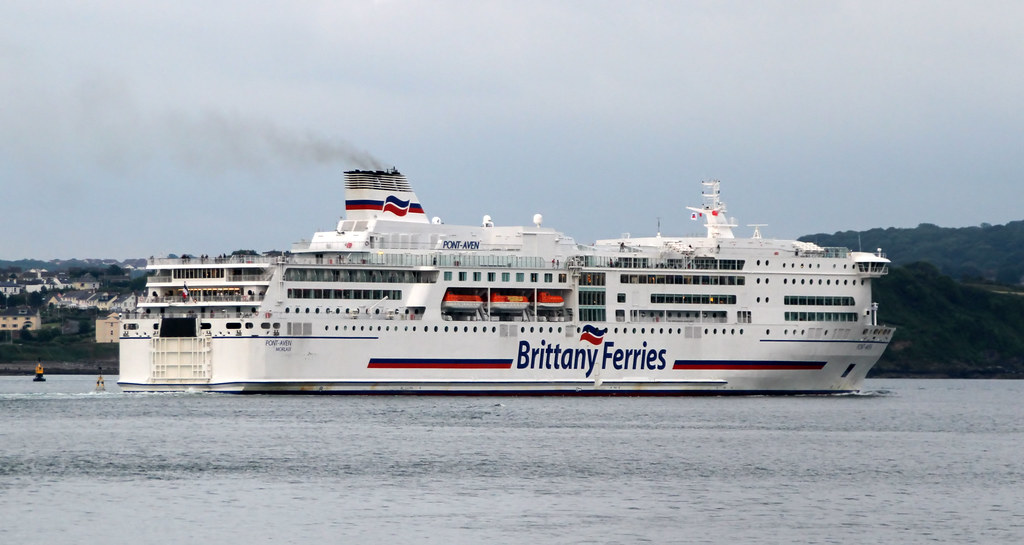
The Plymouth to Roscoff vehicle ferry is operated by either the Armorique (most sailings) or the Pont-Aven (selected Fridays daytime and Tuesdays overnight) — both are well-appointed cruise ferries with restaurants, bars, a shop, entertainment, and cabin accommodation. For the full deck-by-deck breakdown of every facility on both ships, see our complete onboard facilities guide.
🍽️ Dining
Armorique: Self-service restaurant Le Restaurant (deck 7) and café Le Café (deck 6). Pont-Aven: À la carte Le Flora, self-service La Belle Angèle, Le Café du Festival, and piano bar Le Fastnet (all deck 7). Le Grand Pavois main bar on deck 8.
🛏️ Cabins
All cabins include ensuite bathroom, fresh bed linen, towels, soap and shower gel, and air conditioning. Your boarding card is your cabin key. Vacate 30 minutes before arrival. An approximate wake-up signal — ‘Dihun – Le Réveil’ by Carlos Núñez — plays about 1 hour before docking.
The duty-free boutique opens approximately 15 minutes after departure and sells wine, spirits, perfume, and French produce at French prices. Wine and tobacco are not sold within UK territorial waters. Payment accepted in euros or sterling, cash or card. Wine delivery to your car at disembarkation is available on both ships.
🔌 Power Sockets
All cabins have continental 2-pin sockets (220v) plus a 110v shaving socket. UK adaptors are not provided as standard — bring your own, or buy one from the boutique (limited stock). This applies to both the Armorique and Pont-Aven.
👨👩👧 Children & Entertainment
Both ships have children’s soft play, Games Planet (video games and air hockey), two cinemas (not wheelchair accessible), and the Ferrynauts augmented reality app for ages 7–13. Pierre le Bear mascot appears during school holidays. Baby changing on decks 6 and 7 on both ships.
ℹ️ Information Desk
Open 24 hours on both ships. If you lose your boarding card/cabin key, visit with your travel documents. Walk-up cabins are occasionally available on off-peak daytime sailings at a reduced price from the information desk — but do not rely on this as a strategy. The baggage room on deck 6 is locked during the crossing and opens 20–30 minutes before arrival.
💡 Alcohol and driving: France has a lower drink-drive limit than England and Wales — 0.05% BAC versus 0.08%. You’ll be driving off the ship at Roscoff in the morning, often with daytime sailings arriving early evening French time. Plan your evening on board accordingly. There is often a police presence at the port on arrival.
Arriving at Roscoff — Disembarking with Your Vehicle
Overnight sailings arrive at Roscoff at either 08:00 or 10:15 local French time (tidal variation of up to 1 hour). Daytime sailings on Pont-Aven arrive around 20:00 French time. The disembarkation process is orderly — there is no need to rush. You’ll be on French roads for the first time moments after leaving the ship, so a calm start is the right approach. Motorhome and caravan drivers should take particular care on the car deck exit ramps and in the immediate port area.
1
Wake-Up Call & Vacate Your Cabin
On overnight sailings, the wake-up signal — ‘Dihun – Le Réveil’ by Carlos Núñez — plays approximately 1 hour before arrival. You must vacate your cabin and take all belongings at least 30 minutes before docking. Don’t leave anything behind — you cannot return to the cabin.
2
Wait for the Announcement
An announcement is made when passengers may return to their vehicles. Wait in a public area — a lounge or outer deck — so you can clearly hear the call. Crowding at the car deck entrance before the announcement causes congestion on stairways and lifts. Club Plus cabin passengers have priority disembarkation (£15 per vehicle on Armorique).
3
Return to Your Vehicle — Passports Ready
When the announcement is made, proceed to your deck. Have your passports out and ready before you reach the French border control. Passport checks at Roscoff can take time on busy sailings. If travelling with pets, have your AHC and pet documentation ready — your pet’s microchip sticker was placed on your windscreen at Plymouth check-in; do not remove it during the voyage.
4
Drive Off — You Are Now in France. Drive on the Right.
Do not start your engine until instructed by crew. Once clear of the ship at Port de Bloscon, you are driving in France — on the right. Take it slowly leaving the port. The N12 provides the main road connection from Roscoff into Brittany. Roscoff town centre is 15 minutes’ walk from the terminal; taxis are available (approximately €8 to town). EV charge points are located near the terminal, operated by CCI Morlaix — €2 per charge, refill card required in advance.
🇫🇷 Driving in France from Roscoff — What You Need to Know
Taking your vehicle to France gives you complete freedom — your Brittany adventure starts the moment you drive out of Port de Bloscon. But as a UK driver, several rules differ from home, and French police can issue and collect on-the-spot fines in euros. Here is a quick-reference overview — our full Driving in France guide covers everything in complete detail including motorhome and caravan-specific speed limits.
📄 Documents to Carry
Valid passport — all passengers including children
Full UK driving licence — photocard valid in France. Old-style paper licences require an International Driving Permit (IDP)
V5C vehicle registration document
Proof of insurance — check your policy covers France fully; many UK policies reverted to third-party only in the EU post-Brexit
MOT certificate — if the vehicle is over 3 years old
🚗 Required Equipment
Warning triangle — mandatory. Place 30m behind the vehicle on a regular road if broken down
Hi-visibility vest — one per person, stored inside the cab (not the boot)
Headlight beam deflectors — UK right-hand drive headlights dip left, dazzling oncoming drivers. Cheap sticker deflectors available from the onboard boutique
UK identifier — “UK” oval sticker or UK-flagged number plate. The old “GB” sticker is no longer valid since September 2021
Crit’Air sticker — required in 25 French cities including Rennes, Nantes, Brest. Order from certificat-air.gouv.fr (~£4, allow 10 days for delivery)
Motorhomes & caravans over 3.5t GTM: 90 kph motorways maximum
Priorité à droite — at unmarked junctions, vehicles from the right have priority
Drink-drive limit: 0.05% BAC — lower than the UK’s 0.08%
Radar detectors illegal — even switched off. GPS speed camera alerts must also be disabled
Mobile phones banned while driving — including hands-free in some cases; headphones and earphones also illegal
🗺️
Read Our Full Driving in France from Roscoff Guide
Toll roads and Télépéage, motorway aires de repos and aires de service, full speed limit tables including motorhome and caravan limits, Crit’Air cities, priorité à droite explained, fuel types, breakdown procedures, and practical tips for driving in Brittany and beyond — all verified from official sources.
Can I stay in my car on the Plymouth to Roscoff vehicle ferry?
No. The car deck is closed to all passengers for the entire sailing. On overnight sailings, all passengers must book either a cabin or a reserved seat — you cannot board without one. The car deck is sealed after loading and remains inaccessible until the ship docks at Roscoff. This applies to all vehicle types — cars, vans, motorhomes, campervans, and car-and-caravan outfits.
How much does it cost to take a car on the Plymouth to Roscoff car ferry?
A car plus 2 passengers starts from £117 one way on the Plymouth to Roscoff car ferry. A cabin or reserved seat (from £10) is booked separately on top. Prices vary by sailing date, season, and how far in advance you book. Early Bird fares (booking 60+ days ahead) offer the best prices but are non-refundable. Book via Brittany Ferries directly for the best availability and to qualify for our affiliate discount.
Can I take a motorhome on the Plymouth to Roscoff ferry?
Yes — motorhomes and campervans are welcome on the Plymouth to Roscoff motorhome crossing. The maximum dimensions are 4 metres high and 9 metres long, including all roof-mounted equipment. Fares start from £175 including all passengers. A cabin or reserved seat must be booked separately as you cannot stay in your motorhome during the crossing. All parking at Roscoff port is free, with free motorhome overnight areas at Sainte Barbe (1km) and Perharidy (2km).
Can I take a caravan on the Plymouth to Roscoff ferry?
Yes. The Plymouth to Roscoff caravan ferry accepts touring caravans — the surcharge starts from £45+ on top of the standard car fare. Maximum dimensions are 4 metres high and 9 metres total combined length, measured from the front of your tow vehicle to the very back of the caravan including the towbar. Always book as “car with caravan/trailer” from the start. The check-in lanes at Plymouth Millbay have length markings painted on the ground.
How early do I need to check in at Plymouth Millbay for the vehicle ferry?
The standard check-in time for vehicle passengers is at least 45 minutes before departure. If travelling with a pet, check in at least 90 minutes before departure as microchip scanning takes additional time. Check-in can open up to 4.5 hours before departure on some sailings. The terminal address is Millbay, Plymouth, Devon, PL1 3EW — follow Brittany Ferries signs from the A38.
Do I need to disable my car alarm before the Plymouth to Roscoff crossing?
Yes — Brittany Ferries require all vehicle alarms to be disabled before you leave the car deck. If an alarm triggers during the 8–11 hour overnight crossing nobody can access the vehicle to stop it, and the battery will drain completely. This applies to cars, motorhomes, campervans, and any alarm on a caravan. Test your alarm-disable method at home before your trip rather than working it out in the queue at Millbay.
Is parking free at Roscoff port?
Yes — all parking at Roscoff port is free for all vehicle types and at the owner’s own risk. The main car park is free for up to 48 hours, after which you can obtain a permit card from the Brittany Ferries counter for up to one week. Long-stay free parking is available at the entrance of Port de Bloscon above the marina. Free motorhome overnight areas are at Sainte Barbe (1km from port) and Perharidy (2km). This is unlike Plymouth, where car parking charges apply at Millbay.
Do I need a Crit’Air sticker to drive from Roscoff?
You need a Crit’Air sticker to enter any of the 25 low-emission zones (ZFEs) now operating in French cities — including Rennes, Nantes, Brest, and others you may pass through on a Brittany road trip. Order from the official French government website certificat-air.gouv.fr (~£4, allow 10 days for delivery to a UK address). This applies to all vehicle types including motorhomes and caravans.
Does UK car insurance cover me in France?
UK vehicle insurance should usually include EU travel but you must check your individual policy — many UK comprehensive policies reverted to third-party cover only for EU travel since Brexit. Contact your insurer before you travel to confirm your cover in France. A Green Card is no longer compulsory but can be useful as additional confirmation of cover. Motorhome and caravan owners should specifically check that their vehicle type and any towed outfit is included.
Continue Planning Your Plymouth to Roscoff Trip
🐕
Pet Travel Guide
AHC requirements, muzzle rules, pet fines, pet-friendly cabins, exercise areas, and check-in times with pets
Ready to Book Your Vehicle on the Plymouth to Roscoff Ferry?
Summer sailings sell out quickly and fares rise as dates approach. Book early to secure the best price and your preferred sailing — especially important for motorhome and caravan bookings where space is more limited.
This website uses cookies to improve your experience. If you continue to use this site, you agree with it.
We use cookies to ensure that we give you the best experience on our website. If you continue to use this site we will assume that you are happy with it. We also use affiliate links, please see our privacy policy.