Affiliate Disclosure: This site contains affiliate links. If you book through these links we may earn a small commission, at no extra cost to you.
Carantec Day Trip from Roscoff: Complete 2027 Guide
This Carantec day trip guide covers one of the most overlooked and rewarding places to visit from Roscoff: a small Breton peninsula about 25 minutes east along the bay. A tidal island you can walk to at low tide, a headland with one of the finest views in Morlaix Bay, and a Maritime Museum that tells the story of the 297 people recorded as escaping across the bay to England during the Second World War make for a full and memorable day.
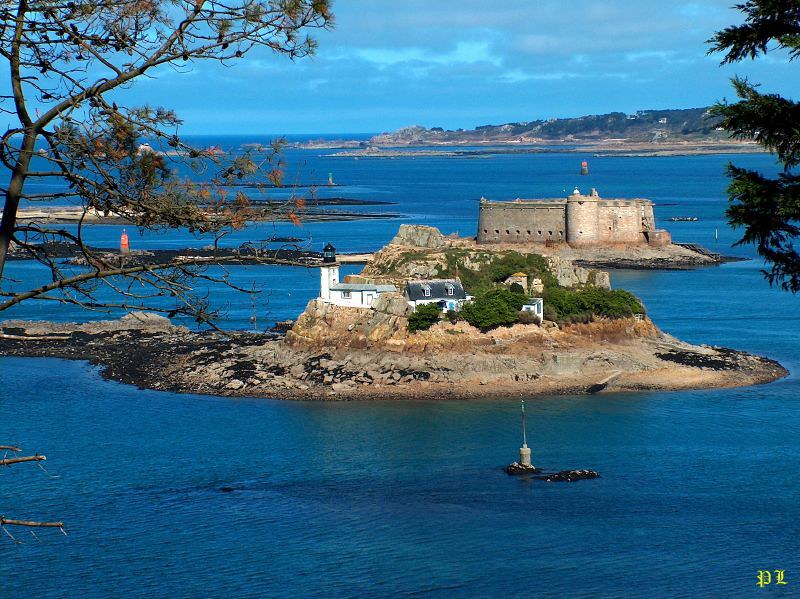
Carantec sits at the western entrance to Morlaix Bay on a peninsula whose eastern tip, the Pointe de Penn al Lann, faces the Château du Taureau, the 16th-century island fortress built to keep the English out. The bay itself, with its scattering of tidal islands, its oyster farms, its lighthouse at Ile Louet (which can be rented as a cottage), and the constant movement of the extraordinary tides, is the main draw. The town’s own beaches are excellent too: Plage du Kelenn has lifeguards in summer and lends beach wheelchairs to visitors with reduced mobility. The coastal walk around Pointe de Penn al Lann, where the Ile Noire rock is visible offshore and a theory links its lighthouse to Hergé’s Tintin adventure The Black Island, is one of the finest easy coastal walks in northern Finistère.
This Carantec day trip guide covers driving directions from Roscoff, how to time the crossing to the tidal island of Ile Callot (and the days when you can’t cross at all), the Penn al Lann headland coastal walk, the beaches and their facilities, the Maritime Museum’s prices and opening hours, the extraordinary WWII Réseau Sibiril story, where to eat, and sample itineraries for combining Carantec with Cairn de Barnenez and Morlaix in a single Morlaix Bay day.
Last updated: October 2026 | Prices and opening times are the latest published by the museum, the Château du Taureau and the Baie de Morlaix tourist office (checked October 2026); check them again for 2027
25 min from Roscoff | Ile Callot Tidal Island | Pointe de Penn al Lann Coastal Walk | 5+ Beaches | Maritime Museum €5 | WWII Escape Story | Château du Taureau Boat Trips
✅Ile Callot — Tidal Island Walk — cross the 800–900m submersible causeway to a seahorse-shaped island at low tide, with a chapel founded in the 6th century, a dragon cave legend and wild beaches. FREE (tide-dependent)
✅Pointe de Penn al Lann — the finest land viewpoint of Château du Taureau and Ile Louet lighthouse in Morlaix Bay, plus the coastal loop through the Parc Claude Goude arboretum. FREE
✅Five-Plus Beaches — Plage du Kelenn (lifeguarded in summer, beach wheelchairs to borrow), Plage de Tahiti, Grève Blanche, Plage du Clouët, Plage du Cosmeur and more. All FREE
✅Musée Maritime de Carantec — WWII escape boats, a virtual reality shipwreck dive, the 297 people recorded as escaping from Morlaix Bay to England, and the de Gaulle family connection. Adults €5, children €3
✅Ile Louet Lighthouse Views — the distinctive white lighthouse visible from all Carantec beaches, standing on its tidal island. The lighthouse keeper’s cottage is available to rent for overnight stays
✅Château du Taureau Boat Trip — about 15 minutes each way by boat from Plage du Kelenn to the island fortress, on tide-dependent dates from about April to September. The most dramatic excursion from Carantec; booking required at chateaudutaureau.bzh or the tourist office
⚠️Ile Callot Tidal Warning: On days with low tidal coefficients there’s no crossing at all. Check the town’s crossing times before you go, and be back at the start of the causeway 30 minutes before the crossing window ends. Monthly timetables are on ville-carantec.com
Why Visit Carantec?
Carantec is the kind of place that people discover by accident and return to deliberately. There are no grand monuments, no queues and no admission charges for most of what it offers, just the slow pleasure of a well-positioned Breton peninsula with exceptional tides, accessible islands, and a bay full of stories.
A Bay Full of Islands and Tides
Carantec occupies a peninsula at the western entrance to Morlaix Bay, one of the most beautiful and layered bays in northern France. From any high point in Carantec, the bay reveals itself in stages: the Château du Taureau on its rock in the middle distance, the white lighthouse of Ile Louet beside it, the long dark shape of Ile Callot stretching north, the distant Ile de Batz to the west, and the Monts d’Arrée on the southern horizon. The tidal range is dramatic, and it shapes everything here: the access to Ile Callot, the character of each beach, the daily rhythm of the oyster farmers working the bay.
The town itself is pleasant rather than spectacular, with good crêperies, some restaurants, a helpful tourist office and enough of a year-round local population to keep things genuine rather than purely touristic. But it is the bay, the beaches and the islands that make a Carantec day trip from Roscoff genuinely worthwhile.
A Welsh Saint, a Dragon, and 297 Escapes to England
Carantec takes its name from Saint Carantec, a Welsh or British monk who settled here in the 6th century and founded the community that became the town. His legend includes driving a dragon into the Toul-ar-Serpent cave on Ile Callot, whose claw marks are still said to be visible on a nearby rock. It follows the same pattern of Welsh-origin founder saints as Saint Paul Aurélien in nearby Saint-Pol-de-Leon, and for visitors arriving from Plymouth by ferry, the Celtic connection between these Breton coastal towns and the western coasts of Britain is one of the most striking historical threads of the whole Léon region.
The WWII history of Carantec is extraordinary. Between June 1940 and February 1944, 297 people are recorded as leaving Morlaix Bay for England by boat. Many were helped by Ernest Sibiril, a Carantec boatbuilder who quietly repaired old hulls and organised one of the most prolific small-boat escape networks on the Breton coast. The Maritime Museum holds one of the boats used in these escapes (Le Requin), as well as the documentation of these individual voyages and a dedicated section on the de Gaulle family, who spent time in Carantec in June 1940 as France fell. For visitors arriving from England, knowing that the boats that crossed this bay in 1940 were heading for the same shores they have just left gives the museum an immediacy unlike any other in the area.
Getting to Carantec from Roscoff
Carantec is around 17–20 kilometres east of Roscoff, about 20–25 minutes by car on toll-free roads.
By Car: About 25 Minutes
Distance: ~17–20km | Drive time: ~25 minutes | Route: D58 south from Roscoff through Saint-Pol-de-Leon, then D173 east toward Carantec | Tolls: None
Leave Port de Bloscon on the D58, pass Saint-Pol-de-Leon (worth a brief stop for the Kreisker chapel and cathedral) and cross the Penzé estuary, then follow the D173 to Carantec. The road descends toward the bay, with the first views of Morlaix Bay opening up as you approach the town.
Parking: There are free car parks around the town and near the beaches. The port car park is the starting point for Ile Callot and fills up quickly in summer, so arrive early and check any time limits on the signs. The car parks at Chemin des Huîtres (start of the coastal walk to Penn al Lann) and at the beaches all have free parking outside peak season; some charge in July/August.
By Bus: Via Morlaix
There’s no direct bus from Roscoff to Carantec. Foot passengers can take the BreizhGo line 29 bus to Morlaix (about 35 minutes) and change to the local 929 bus to Carantec, which takes around 2 hours in total with the connection. With infrequent buses and the Ile Callot tide windows to fit in, a car makes the day much easier. If you do go by bus, check both timetables before travelling. In July and August a free shuttle bus has run around Carantec itself, which helps once you’re there.
Combining Carantec in a Morlaix Bay Day
Carantec combines well with the rest of Morlaix Bay. Morlaix itself is about 20 minutes south. The Cairn de Barnenez (€7 adults, Europe’s largest megalithic mausoleum) looks across the bay at Carantec, but by road it’s about 30 minutes away, round through Morlaix. Done in the order Carantec, Morlaix, Barnenez, the three make an excellent full day from Roscoff, with an easy 40-minute drive back to the port at the end.
Musée Maritime de Carantec: Hours & Admission
The Maritime Museum is Carantec’s main indoor attraction and the best place to understand the WWII story of the people who crossed Morlaix Bay to reach England.
Important: The museum opens in the afternoons from mid-June to mid-September and in the French school holidays. At other times it’s open to groups by appointment only. Check the current opening schedule with the museum or the Carantec tourist office before visiting. It’s run by a volunteer association: a small, passionate operation with an outsized story.
Period
Opening hours
Mid-June to mid-September (15 June–20 September)
14:30–18:30 daily, closed Thursdays
French school holidays (other times of year)
Same hours: 14:30–18:30, closed Thursdays
Rest of the year
Groups by appointment only — 02 98 67 00 43
Admission Prices
Adults: €5 | Children (6–18): €3 | Family pass (2 adults + 2 children): €12 | Groups (over 8): €4 per person
Heritage Days (Journées du Patrimoine): Free entry, donations welcome. Address: rue Albert Louppe, 29660 Carantec, in the town centre. Under-6s go free. These are the latest published prices (Baie de Morlaix tourist office); check for 2027.
The Maritime Museum: What’s Inside
The Musée Maritime de Carantec is a small, volunteer-run museum with an unexpectedly large story. Allow 1–1.5 hours. Visitors regularly praise the passionate welcome from the volunteers and the quality of the exhibits for a museum of its size. The collection is organised around boats used for work, for pleasure and for escape.
🚤 The WWII Escape Boats and the Sibiril Network
The most compelling section of the museum tells the story of the escapes from Morlaix Bay during the German Occupation, and of the clandestine network run by Ernest Sibiril, from a family that had built boats in Carantec for generations. Between June 1940 and February 1944, 297 people are recorded as having left Morlaix Bay by boat to reach England: resistance fighters, Jewish families, Allied airmen shot down over Brittany, and others fleeing the Occupation. The crossing was made in small fishing and sailing boats, at night, often in rough sea conditions, across a Channel patrolled by the German Navy. The museum holds Le Requin, one of the boats used in these escapes.
The museum also has a section on the de Gaulle family’s presence in Carantec in 1940: Yvonne de Gaulle and the children were staying here when General de Gaulle broadcast his famous appeal from London. The combination of the Sibiril network and the de Gaulle connection gives Carantec a direct and personal role in one of the most important moments of French history. For British visitors in particular, knowing that the people on these boats were heading for England, the same coast you have just left, gives the exhibit a rare immediacy.
🚢 Shipwrecked Boats
The story of L’Alcide, a Saint-Malo corsair ship wrecked off Carantec in 1747, and the objects recovered from it. There’s also the Aboukir Bay exhibition and a virtual reality experience: dive the wreck of the Aboukir Bay, a three-masted sailing ship lost in a storm in 1893 and rediscovered in 1976, which now lies at 25 metres depth within a Natura 2000 protected site and has become an extraordinary marine ecosystem. The VR dive experience (using headsets available in the museum) has been praised by visitors as genuinely impressive.
🦪 Working Boats
The traditional working life of Morlaix Bay: fishing, oyster farming (ostréiculture), seaweed harvesting on Callot (goémoniers), and the boat-building tradition that made Carantec a notable Finistère shipyard. Scale models, tools, and personal objects tell the story of communities whose daily lives were shaped entirely by the tides and the bay.
⛵ Pleasure Boats
Le Cormoran, the celebrated Carantec sailing dinghy, along with the early sailing schools, the regattas, and the boat-building heritage that continues in Carantec today. This section gives context to the town’s strong sailing culture and the bay’s popularity with recreational sailors.
Ile Callot: Crossing to a Tidal Island
Ile Callot is the most exciting thing to do in Carantec, and the most tide-dependent. Read this section carefully before you go.
⚠️ Critical Tidal Information: Read Before You Go
The causeway can only be crossed around low tide. The town publishes the exact crossing times for every day of the month; the window depends on the tidal coefficient, from under an hour on small tides to more than four hours on big ones. There are usually two windows in 24 hours, and some fall at night.
On days with low tidal coefficients (neap tides) the crossing is NOT possible at all. Several days a month are marked “no crossing” in the timetable, and many visitors have been caught out by this.
Be back at the start of the causeway 30 minutes before the crossing window ends, as the town advises, and never set off if water is already over the road. The tide returns fast, and you cross at your own risk. The monthly crossing timetables (PDFs, in French but the times are clear) are on the Ile Callot page of ville-carantec.com, and the times are also posted at the port.
The Island — What to Expect
Ile Callot is just over 2km long and shaped like a seahorse, roughly 15 to 300 metres wide at different points, with its highest point (38 metres) at the chapel. The causeway from the Carantec port, around 800–900 metres long, is a road that is under water at high tide and revealed as the sea goes out. Walking it is one of the highlights of the visit: children collect shells and paddle in the shallows, fishermen work the exposed sand for shellfish, and the view of the bay opens progressively as you move further from the shore.
On the island itself, a handful of families live year-round (9, by local accounts), with many more in summer. There are no cafés, no shops and no facilities beyond public toilets, so bring your own food and water. Walking the island end to end and back is about 6km (the tourist board’s island loop is 6.5km); allow 1.5–2 hours. The northern section is wilder — dunes, gorse, and rocky headlands. The chapel of Notre-Dame de Callot, on the highest point of the island, is the main landmark: a pilgrimage chapel that tradition says was first founded in the early 6th century by a Breton chieftain, with a 360° view from the top of the island. Inside, the granite interior is simple and peaceful. The Toul-ar-Serpent cave on the north shore is where Saint Carantec is said to have slaughtered the dragon whose claw marks remain visible on a nearby rock.
Cars: Visitors’ cars are banned from the island in July and August, during big spring tides and on long weekends, so park at the Carantec port and walk the causeway. Even when driving is allowed, walking is the way to experience it. The old school building is now a holiday gîte (sleeping around 10) that can be booked online through the Baie de Morlaix tourist office (baiedemorlaix.bzh) if you want to actually sleep on the island.
Cockle and clam fishing on the causeway: As the tide drops and the causeway is revealed, the exposed sand and rock pools on either side of the path are one of the best spots in northern Finistère for pêche à pied — fishing on foot. Cockles and clams are the main prize; all you need is a small rake and a bucket. This is a free, family-friendly activity and a traditional Breton experience; the locals do it with the same enthusiasm as the tourists. Children in particular love the hunt. Check the local rules on minimum sizes and quantities, and any temporary bans for water quality, which are posted locally.
Carantec has more to offer than the tidal island. Here is everything else worth seeing on a day trip.
🥾 Pointe de Penn al Lann: The Coastal Loop Walk
Distance: 4.8km loop | Time: ~1 hour | Difficulty: Easy | Cost: FREE | Start: Chemin des Huîtres car park near Parc Claude Goude
The coastal loop walk from the Chemin des Huîtres around Pointe de Penn al Lann, past Plage de Tahiti and back is one of the finest easy coastal walks in northern Finistère. It follows the GR34 Sentier des Douaniers along the headland, passing through the Parc Claude Goude arboretum and arriving at Pointe de Penn al Lann for the best land view of Château du Taureau and Ile Louet in the bay.
From the headland and Plage de Tahiti, the view looks straight across to Ile Louet with its white lighthouse and the dark shape of Château du Taureau beside it. Offshore, Ile Noire is visible: the long dark rock whose lighthouse is said to have inspired Hergé when he wrote The Black Island, a Tintin adventure set on a Scottish island. The path is well-marked, the terrain is easy, and the views improve throughout. The northern section is widely considered the most beautiful stretch.
Along the GR34 section of the walk, look out for La Chaise du Curé, a rocky outcrop above the coastal path named after the parish priest of Carantec during the First World War, who was said to sit here on a flat rock reading his breviary aloud to the sea. It is now one of the best-known viewpoints on the Carantec coast and a named landmark on local trail maps (a restaurant near the church borrows its name). The combination of the Château du Taureau directly opposite, Ile Louet and its lighthouse to the right, and the full sweep of the bay makes this one of the finest coastal stopping points in northern Finistère.
🏖️ Plage du Kelenn: Main Beach
Carantec’s main and best-known beach. Lifeguard cover in July and August, daily 12:00–19:00 (3 July to 29 August in 2026). It has an access ramp, an accessible seafront promenade and accessible toilets, and Tiralo and Hippocampe beach wheelchairs can be borrowed from the lifeguard post (book ahead in summer). Restaurants and bars with outdoor seating overlook the beach, the sailing centre offers kayak, paddleboard, sailing and other water sports, and the Château du Taureau boats leave from here. A wide sandy beach that changes dramatically with the tides, with the GR34 coastal path running along the shore.
🏖️ Plage de Tahiti
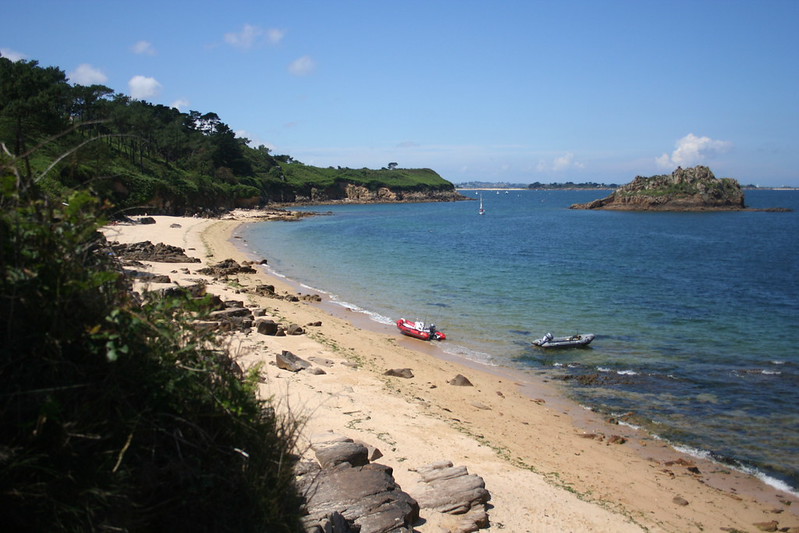
A small, sheltered beach close to Pointe de Penn al Lann, among granite and pines, with magnificent views of the Ile Louet lighthouse and the Château du Taureau fortress. The name hints at something exotic; in practice it is a classic Breton cove, but with the bay view and the warm light of a Brittany afternoon, the name starts to feel less absurd. A highlight of the Penn al Lann coastal walk, and lovely at high or low tide.
🏖️ Grève Blanche
North-facing beach with a diving board. Access from the Rue de la Grève Blanche car park or via the coastal path for pedestrians. Restaurants and bars nearby. Its exposed position means it catches the wind, and on a breezy day Grève Blanche has an energetic, raw character that the more sheltered beaches lack. Popular with water sports enthusiasts and those who prefer a less manicured feel.
🏡 Ile Louet Lighthouse Cottage
The small island of Ile Louet, beside the Château du Taureau, has a charming white lighthouse and a lighthouse keeper’s cottage that can be rented as holiday accommodation: a unique chance to sleep beside a working lighthouse in the middle of Morlaix Bay. Managed by Morlaix Communauté. Bay cruises and the Château du Taureau boats also give you a closer look at the island. Enquire at the tourist office for current availability and booking information.
⚓ Château du Taureau: Boat Trip from Carantec
The Château du Taureau, the island fortress that dominates every view across Morlaix Bay, can be visited by boat from Plage du Kelenn in Carantec (most departures) or from Le Diben in Plougasnou. The crossing from Carantec takes about 15 minutes each way (longer from Le Diben), followed by around an hour’s semi-guided visit. Originally built in the 16th century to defend Morlaix against English raiders, it was later remodelled by Vauban, served as a state prison, and now opens for visits on tide-dependent dates from about April to September. In 2026 adults paid €22 (including the boat) and children aged 4–12 €12. The boat trip itself is scenic and the fortress is well-restored with 360° panoramic views of the bay from its terraces. Activities include historic guided tours, theatrical evenings, storytelling for children, and picnic areas within the castle walls. Book in advance at chateaudutaureau.bzh, by phone or at the Carantec tourist office; booking is required and the boats don’t take walk-ups. See our Château du Taureau guide for more.
Where to Eat in Carantec
Carantec has a good range of eating options for its size, from gastronomic dining to simple beachside crêperies.
Eating Options
Carantec has approximately a dozen restaurants. At the gastronomic end, the Hôtel de Carantec on rue du Kelenn has a long tradition of fine dining with a sea view (its restaurant is now run by chef Nicolas Carro), and Carantec has hosted Michelin-starred dining in the past. For everyday eating there are crêperies, seafood brasseries and bars with outside seating on the beachfront, plus La Chaise du Curé, a restaurant and crêperie near the church. For a day trip, the best approach is one of the beachfront venues for a galette or moules marinières lunch, with the bay as the view. Most restaurants are clustered in the town centre and around Plage du Kelenn, and in summer it’s worth booking for lunch on sunny days.
Picnic option: Given Carantec’s extraordinary beach and island settings, a picnic from Roscoff or Saint-Pol-de-Leon is one of the most satisfying lunch options — buy supplies before you arrive, then eat on the Kelenn seafront or at Plage de Tahiti with the Château du Taureau in view (there are picnic areas at the Kelenn and Clouët beaches and on Ile Callot), or on the Ile Callot after crossing the causeway (bring everything with you as there is nothing on the island). The Carantec tourist office (4 rue Pasteur) is well regarded and can tell you which restaurants are open on any given day.
Sample Carantec Day Trip Itineraries
Two approaches: one purely in Carantec, one combining the full Morlaix Bay experience.
Half Day: Carantec Beach & Island (4–5 Hours)
Perfect for: Families, beach lovers, those wanting to experience Ile Callot on a good tide
Check the crossing times the night before and plan to arrive near the start of a daytime crossing window
Drive from Roscoff (~25 min) and park at Carantec port
Cross to Ile Callot on foot (~20 min across causeway). Explore island: chapel, dragon cave, wild northern beaches. Allow 1.5–2 hours total on island.
Return in good time: be back at the start of the causeway 30 minutes before the window ends
Lunch at a beachfront crêperie near Plage du Kelenn or a picnic on the beach
Penn al Lann coastal walk (~1 hour, 4.8km loop): the bay view in the afternoon light is exceptional
Full Day: Morlaix Bay Circuit (8–9 Hours)
Perfect for: History fans who want to combine three Morlaix Bay highlights in summer, when the museum and the Cairn de Barnenez have their longest hours
09:30: Drive from Roscoff to Carantec (~25 min). If the tide suits, cross to Ile Callot straight away; if not, do the Penn al Lann walk first.
10:00–12:00: Ile Callot: causeway crossing, island walk, chapel (or the Penn al Lann loop)
12:00–13:30: Lunch on the Kelenn seafront
14:30–15:30: Maritime Museum (opens 14:30; closed Thursdays): escape boats, the Sibiril network, the de Gaulle family connection
15:30: Drive to Morlaix (~20 min) for a walk under the viaduct and through the old town (free)
16:45: Drive on to the Cairn de Barnenez (~15–20 min); in July and August it’s open until 18:30 (last entry 18:00), €7 adults or €5.50 with your Brittany Ferries ticket
18:15: Drive back to Roscoff (~40 min), or stop for dinner in Morlaix on the way
Top Tips for Your Carantec Day Trip
Always check the Ile Callot crossing times before leaving Roscoff: Download the month’s timetable from the Ile Callot page of ville-carantec.com the evening before. On days marked “no crossing” (low tidal coefficients) you can’t get across at any time of day. Planning around this is the single most important thing for a Carantec day trip.
Bring everything you need to Ile Callot: No cafés, no shops, no facilities beyond toilets. Pack water, food, sun protection, and a windproof jacket. The northern part of the island is exposed. Children need close supervision near the water.
The Maritime Museum opens at 14:30 and is closed on Thursdays: It can’t be visited in the morning, and outside mid-June to mid-September it only opens in the French school holidays. Build your itinerary around this: beach and island walk in the morning, museum in the afternoon.
Use the Carantec tourist office: It’s well regarded, and staff can provide current crossing times, restaurant recommendations, Château du Taureau bookings and the latest Ile Callot information. Address: 4 rue Pasteur.
The Penn al Lann walk is best on a clear day: The principal reward is the bay view of the Château du Taureau, Ile Louet and Ile Noire. In mist or heavy overcast the walk is pleasant but the iconic view is obscured. Check the forecast before prioritising this over a beach visit.
Combine with Morlaix and the Cairn de Barnenez: Morlaix is about 20 minutes from Carantec, and the Cairn de Barnenez about 15–20 minutes beyond it, on the far side of the bay. Visited in that order, the three make a natural Morlaix Bay day without backtracking, and one of the finest full days from Roscoff.
Carantec Day Trip: Frequently Asked Questions
Is Carantec worth visiting from Roscoff?
Yes, particularly if you want a day that combines beaches, a tidal island walk, a coastal path and a moving WWII museum. Carantec is not a destination for grand monuments or famous landmarks; it’s a Breton peninsula that rewards a slower approach: crossing a tidal causeway on foot, swimming in a bay with an island fortress in the background, and learning the story of the 297 people recorded as crossing from that same bay to England in small boats during the Occupation. At 25 minutes from Roscoff on toll-free roads, it is also one of the easiest half-days available from the port.
Can you walk to Ile Callot from Carantec?
Yes. Ile Callot is reached on foot by a submersible causeway (around 800–900 metres) that can only be crossed around low tide. The town of Carantec publishes the exact crossing times for every day on ville-carantec.com; the window depends on the tidal coefficient, and on days with low coefficients there’s no crossing at all. Visitors’ cars are banned in July and August, during big spring tides and on long weekends, so park at the Carantec port and walk. The crossing takes 20–30 minutes on foot. Be back at the start of the causeway 30 minutes before the window ends, and never set off if water is already over the road.
How much is the Carantec Maritime Museum?
Admission is €5 for adults, €3 for children aged 6–18, €12 for a family pass (two adults and two children) and €4 per person for groups of more than eight, at the latest published prices. The museum is on rue Albert Louppe in the centre of Carantec. It’s open from mid-June to mid-September and in the French school holidays, 14:30–18:30 every day except Thursday. At other times visits are for groups by appointment (02 98 67 00 43). Admission has been free on the Journées du Patrimoine (Heritage Days) weekend in September.
How far is Carantec from Roscoff?
Carantec is around 17–20 kilometres from Roscoff, about 20–25 minutes by car via the D58 past Saint-Pol-de-Leon and then the D173. The roads are toll-free. There’s no direct bus: by public transport you need the line 29 bus to Morlaix and the local 929 bus out to Carantec, around 2 hours in total. A car is strongly recommended, especially if you want to plan your visit around the Ile Callot crossing times.
Does Tintin’s Black Island have a connection to Carantec?
There is a local tradition that the lighthouse on Ile Noire, the dark rock visible offshore from Carantec’s Pointe de Penn al Lann, inspired Hergé when he wrote The Black Island, a Tintin adventure published in 1938. Hergé is known to have spent time in Brittany, and the rock’s distinctive dark profile and its lighthouse are suggestive. France-voyage.com describes the connection as a theory rather than a confirmed fact. Whether or not Hergé drew directly from Ile Noire, the visual parallel is striking and the story adds an enjoyable dimension to the Penn al Lann coastal walk.
Can you visit the Château du Taureau from Carantec?
Yes. Most Château du Taureau boats leave from Plage du Kelenn in Carantec, with some from Le Diben in Plougasnou. The crossing from Carantec takes about 15 minutes each way (around 45 minutes from Le Diben), and the visit is a semi-guided tour of around an hour. Trips run on tide-dependent dates from about April to September and must be booked in advance online, by phone or at the tourist office. In 2026 adults paid €22 and children aged 4–12 €12, including the boat.
Which Carantec beach has lifeguards?
Plage du Kelenn, Carantec’s main beach, has lifeguards every day from 12:00 to 19:00 in July and August. It’s also the most accessible beach, with a ramp, an accessible promenade and toilets, and Tiralo and Hippocampe beach wheelchairs to borrow from the lifeguard post. The other beaches, including Plage de Tahiti, Grève Blanche, Clouët and Cosmeur, are unsupervised.
Continue Planning Your Plymouth to Roscoff Trip
🗺️
All Day Trips from Roscoff
Ile de Batz, Morlaix, Brest, Saint-Pol-de-Leon, Pink Granite Coast and more
Brittany Ferries sails from Plymouth Millbay to Roscoff from March to November (21 March to 7 November in 2027). Drive 25 minutes east and walk out to a tidal island on the same bay where a Welsh monk settled in the 6th century and gave the town his name.
This website uses cookies to improve your experience. If you continue to use this site, you agree with it.
We use cookies to ensure that we give you the best experience on our website. If you continue to use this site we will assume that you are happy with it. We also use affiliate links, please see our privacy policy.