Affiliate Disclosure: This site contains affiliate links. If you book through these links we may earn a small commission, at no extra cost to you.
Cairn de Barnenez: Complete Visitor Guide 2027
The Cairn de Barnenez is described by Brittany’s tourist board as Europe’s largest megalithic mausoleum and the oldest known megalithic building on the European mainland. It is a vast stepped burial mound on the Kernéléhen peninsula above Morlaix Bay, built around 6,500 years ago by some of the first farming communities in Brittany, around 2,000 years before the Great Pyramid of Giza and some 1,500 years before the first monument at Stonehenge. André Malraux, French novelist and Minister of Culture, called it the “Prehistoric Parthenon.” Pierre-Roland Giot, the archaeologist who excavated it, described monuments like this as architectural witnesses to an essential phase of Western European civilisation. In 1955 it came close to being quarried away by a road-building contractor.
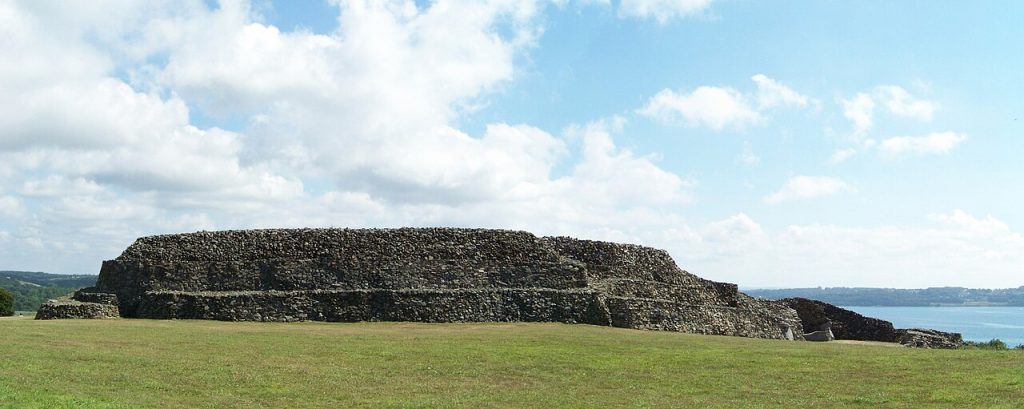
Standing on the headland above Térénez cove, the cairn is some 72–75 metres long, up to 25–28 metres wide and around 9 metres tall: a stepped, dry-stone structure covering eleven burial chambers, each reached by a stone-lined corridor. The chambers are oriented to face the rising sun. Inside, the walls of several corridors bear engravings: axe blades, bows, shield symbols, and zigzag motifs carved by Neolithic hands that are among the oldest decorative art in France. Chamber H contained the only painted decoration anywhere in the cairn. From the terrace beside the monument, the view across Morlaix Bay to the Sept Îles archipelago on the horizon is one of the finest in northern Finistère.
The cairn faces Roscoff across Morlaix Bay, but by road it’s about 40 kilometres and 40 minutes from the ferry port, via Morlaix, which makes it an easy half-day trip or part of a full Morlaix Bay day. This guide covers prices and opening hours, the guided tour, the extraordinary near-destruction story, how to read what you are looking at on site, and how to combine the visit with the Château du Taureau for a full Morlaix Bay day.
Last updated: October 2026 | Prices and opening hours checked on barnenez.fr (Centre des Monuments Nationaux) in October 2026; check them again for 2027 before you visit
The Prehistoric Parthenon — 40 Minutes from Roscoff
Europe’s largest megalithic mausoleum | Built c.4,500 BC | 11 burial chambers | €7 adults (€5.50 with Brittany Ferries ticket) | FREE under-18s | Free guided tour included | Morlaix Bay views | Free parking
Construction date
~2,000 yrs before Giza, ~1,500 before Stonehenge
✅Europe’s Largest Megalithic Mausoleum — some 72–75 metres long, 11 burial chambers, built in two phases from c.4,500 BC. Called the “Prehistoric Parthenon” by André Malraux, and around 2,000 years older than the Great Pyramid of Giza.
✅Free Guided Tour Included — approximately 45 minutes, conducted in French. Free visit documents available in 8 languages including English. Register on arrival — no advance booking required.
✅Extraordinary Views — the cairn sits on the Kernéléhen peninsula overlooking Térénez cove and Morlaix Bay. On a clear day the Sept Îles archipelago is visible on the horizon from the site terrace.
✅Brittany Ferries Partnership Discount — admission reduced from €7 to €5.50 for Brittany Ferries ticket holders. Show your boarding pass or ticket confirmation at the reception desk.
✅Free Parking — the car park at the Cairn de Barnenez is free. No booking required. In July and August arrive before 10:00 for the best experience before coach groups arrive.
⚠️Not wheelchair accessible. The site involves walking on uneven terrain. Pushchairs are technically allowed but access is difficult. See the visitors with disabilities page on barnenez.fr or call 02 98 67 24 73.
⚠️Dogs not permitted on site. The nearest restaurant is in Plouézoc’h village, about 4km away. No food or drinks are sold at the monument itself — bring a picnic to enjoy on the headland terrace with the Morlaix Bay views.
Cairn de Barnenez Prices & Opening Hours
These are the prices and opening hours published on barnenez.fr, the official Centre des Monuments Nationaux website (checked October 2026). The monument is open all year, but hours change through the seasons, so check them again for your 2027 dates.
Ticket type
Price
Individual full price
€7
Reduced rate (partnerships)
€5.50
Under-18s (all nationalities)
FREE
EU nationals and regular residents of France aged 18–25
FREE
SNCF Grand Voyageur card holders
€4
Disabled visitors + 1 companion
FREE
Jobseekers / valid Pass Éducation
FREE
Period
Opening hours
1–30 April
10:00–12:30 and 14:00–17:30
2 May–30 June
10:00–12:30 and 14:00–18:30
1 July–4 September
10:00–18:30 (continuous)
5–30 September
10:00–12:30 and 14:00–17:30
1 Oct–31 March (Closed Mondays)
10:00–12:30 and 14:00–17:30
💡 Brittany Ferries Discount — Save €1.50
Brittany Ferries is listed by barnenez.fr as one of the monument’s partners. Show your Brittany Ferries ticket or booking confirmation at the reception desk to pay the reduced rate of €5.50 instead of €7. The same partnership rate applies with: Château du Taureau (CCI Morlaix) | Gîtes de France Bretagne | SNCF TGV Inouï | Château de Kerjean | Océanopolis | Coupon Loisirs en Finistère. Admission is free on the first Sunday of every month from November to March, which is useful if you’re travelling early or late in the ferry season.
Last admission 30 minutes before closing. Closed 1 January, 1 May and 25 December, and on Mondays from 1 October to 31 March. The monument can also close exceptionally for works (it closed for part of March in 2026), so always check barnenez.fr before you set off.
The Story of the Cairn: 6,500 Years and a Near Miss
The Cairn de Barnenez has a remarkable history, not only for what it is but for how close it came to being lost entirely.
c.4,500 BC: The Building of Kerdi Bras
The people who built the Cairn de Barnenez, known in Breton as Kerdi Bras (“big pile”), were among the first settled inhabitants of Armorica, the ancient name for north-western France. They kept livestock, grew crops, made pottery and wove cloth. They also built in stone on a scale that was remarkable for its time.
The cairn was constructed in two phases. The primary cairn, the eastern section containing five of the eleven chambers, was built first, using local dolerite, a dark volcanic rock found in abundance on the Kernéléhen peninsula. The secondary cairn was added later, extending the structure to the west and adding six further chambers, this time using granite sourced from the nearby Île de Sterec. The two phases can be distinguished today by the colour and texture of the stone. The chambers are reached by long stone corridors, all facing south-south-east, towards the rising sun at certain times of year. Inside, the walls of several corridors bear engravings: axe blades, bows, and carved motifs that archaeologists classify as belonging to the tradition of Atlantic megalithic art.
The finished structure, some 72–75 metres long and built entirely of dry stone without mortar, required an estimated 6,500 to 7,000 cubic metres of stone weighing between 12,000 and 14,000 tonnes. The organisation this implies, around 1,500 years before the first monument at Stonehenge and some 2,000 years before the Egyptian pyramids, remains astonishing. Pottery, stone axes and arrowheads found in the chambers suggest the site was used for burial over many centuries.
1954–55: The Contractor, the Journalist and the Archaeologist
By the early 20th century the cairn, its true nature long forgotten, was simply known locally as a large mound of stones on the Barnenez headland. In November 1954, a road-building contractor tasked with constructing the tourist road to Pointe de Térénez negotiated with the landowner to quarry the stones from the two mounds on the Barnenez peninsula. The smaller mound, Kerdi Bihan, was destroyed entirely. In spring 1955 the contractor’s machinery turned on the larger mound, the cairn itself. Chambers A, B, C and D were ripped open. Their stone-lined corridors were exposed to daylight for the first time in 6,000 years.
At this point Francis Gourvil, a writer and journalist covering the story for Ouest-France, recognised what he was looking at. He immediately contacted Pierre-Roland Giot, Director of Prehistoric Antiquities for Brittany and one of the leading Neolithic archaeologists in France. Giot visited the site and understood at once. He alerted the authorities. The excavation machinery was stopped. The contractor faced legal proceedings under the 1941 archaeology law.
On 18 January 1956 the cairn was listed as a Historic Monument, an urgent listing driven by the damage already done. Giot immediately began excavation and restoration work with architect R. Lisch, a programme that continued until 1968. Today, small slate markers embedded in the surface of the cairn discreetly indicate which sections were reconstructed during the restoration — an honest record of what was damaged and what survived. Without Gourvil’s alertness and Giot’s intervention, the “Prehistoric Parthenon” might well have ended up as road ballast. The silver lining is that the damage exposed the inside of the cairn, which helped archaeologists understand how it was built.
💬 “The Prehistoric Parthenon” — André Malraux
André Malraux, the French novelist, Resistance fighter and de Gaulle’s Minister of Cultural Affairs, is credited with calling Barnenez the Parthénon de la Préhistoire, the Prehistoric Parthenon; it is also often called the Parthénon mégalithique (the Megalithic Parthenon), a phrase associated with Pierre-Roland Giot, the archaeologist who saved and excavated the Cairn de Barnenez. The comparison is not about scale but significance: as the Parthenon stands for the high point of classical Greek building, Barnenez stands for the ambition of the early Neolithic communities of Atlantic Europe, and it is a landmark in the story of European megalithic architecture.
What to See on Your Visit
Here is what you will encounter, in sequence, on a visit to the Cairn de Barnenez, what to look for and what it means.
🏛️ The Exterior — Two Cairns in One
Seen from the approach path, the cairn looks like a long, stepped pyramid of dark stone, broader at the base, stepped up in a series of terraces to its nine-metre height. What appears to be a single structure is actually two cairns built one after the other and merged. Look carefully at the stonework: the eastern section (primary cairn) uses darker, rougher dolerite; the western section (secondary cairn) uses lighter, more regular granite. Where the two phases meet, the joint is visible in the facing. Small slate plaques flush with the surface mark the sections restored in the 1956–1968 campaign, a candid acknowledgement of the contractor’s damage.
🪦 The Eleven Dolmens
Eleven burial chambers are incorporated within the cairn, each reached by a stone-lined corridor and designated with a letter (A through J, plus G1). The corridor entrances are visible in the south-facing façade as dark rectangular openings in the stone mass. Some have monumental trilith entrances (two upright stones supporting a horizontal lintel); others are more modest. The chambers themselves are not entered by visitors for conservation reasons, but the corridor openings and the dramatic structure of the façade are viewed at close range during the guided walk. Chamber H, according to Pierre-Roland Giot, is the most spectacular of all the dolmens — with the most spacious and carefully constructed corridor of any chamber in the complex.
✏️ The Engravings
Several of the chambers’ passage walls bear carved engravings, among the oldest decorative art in France. The motifs include axe blades, bows, zigzag lines (associated with snakes or water), and shield-like symbols. The most significant of the shield engravings — found carved into a ceiling slab in the corridor of chamber J — is described on barnenez.fr as an “escutcheon” or shield, a recurring Neolithic motif long associated with a representation of the mother goddess, and the central element around which many other motifs are organised. Chamber H, according to the official barnenez.fr heritage site, contains the greatest concentration of engravings of all eleven chambers, and is the only one in the cairn with traces of painted decoration, a detail that changes how we picture the interior in use 6,500 years ago. The engravings are described in detail during the guided tour and illustrated in the visitor centre exhibition. Pottery shards, polished stone axes and arrowheads found in the chambers can also be seen in the exhibition.
🌊 The View from the Terrace
The cairn sits on a headland that the Neolithic builders chose with care: elevated above the surrounding coast, visible from the sea, commanding views in every direction. From the terrace area beside the monument, the view stretches across Térénez cove and the full expanse of Morlaix Bay. On a clear day the Sept Îles archipelago is visible to the east, the Île de Batz to the north-west, and the Pointe de Primel headland to the east. The Château du Taureau sits on its rocky islet in the middle of the bay. This panorama alone makes the visit worthwhile even before you reach the monument.
🏛 The Visitor Centre
The visitor centre at the entrance to the site contains the reception and ticket desk, an introductory exhibition covering the history, archaeology and restoration of the cairn, and reproductions of the engraved symbols found on the corridor walls. The centre is the place to collect your free visit document (available in English, French, Breton, German, Italian, Spanish, Czech and Dutch), register for the free guided tour, and buy publications about the site. You can also download the English visit document from barnenez.fr before you go, which is handy if you want to read up on the ferry. A small selection of books, prints and souvenirs is on sale.
🚶 The GR34 Connection
The GR34 coastal path, once voted France’s favourite long-distance trail, passes approximately 400 metres below the cairn, at the Barnenez village level. After visiting the monument, take the road down to Barnenez village and turn left onto the GR34 to walk a section of the path along Morlaix Bay. The path in this direction heads east towards Térénez and Plougasnou, with fine views back up to the cairn on its headland. The cairn is listed as a point of interest on mongr.fr (the FFRandonnée’s official GR34 digital map) for walkers on the path. For cyclists, the site also lies on La Vélomaritime / EuroVelo 4, the long-distance cycle route along the Brittany coast, on the Morlaix to Plougasnou stage; the official site gives the ride from Plouézoc’h as 4.2km, about 15 minutes.
Getting There from Roscoff
The Cairn de Barnenez looks across Morlaix Bay towards Roscoff, but the road has to go round the bay through Morlaix. It’s still an easy drive, and one of the least well-known sights among ferry passengers.
Route: Leave Roscoff on the D58 towards Morlaix. At Morlaix, the official directions are to leave the N12 at the Vierge Noire roundabout (exit Morlaix–Lanmeur), then follow signs for Plouézoc’h; the road runs up the east side of the Morlaix river towards the bay. From Plouézoc’h, follow signs for the Cairn de Barnenez on the Kernéléhen peninsula. Address for sat nav: 111 route du Cairn, Presqu’île de Kernéléhen, 29252 Plouézoc’h.
Parking: Free car park directly at the site. In July and August, the car park can fill with coach groups by mid-morning, so arrive close to the 10:00 opening for the quietest visit, and ask at reception for the day’s guided tour times.
Without a Car: Bus, Train or Bike
There’s no direct public transport from Roscoff. Foot passengers can take the BreizhGo line 29 bus to Morlaix (about 35 minutes); the official site says Morlaix station is 15km from Plouézoc’h, and from there you’ll need the local bus, a taxi or a lift. Local buses from Morlaix to the cairn have run only every few hours, so check the timetable carefully or take a taxi. By bike, the cairn is on La Vélomaritime (EuroVelo 4) on the Morlaix to Plougasnou stage, a lovely ride along the estuary. See our cycling guide for taking a bike on the ferry.
💡 Tip: Combine with Carantec or Château du Taureau
The cairn is on the eastern shore of Morlaix Bay. Château du Taureau boat trips leave from two places: Le Diben port in Plougasnou, just up the coast from the cairn (about 15 minutes’ drive), and Plage du Kelenn in Carantec, on the opposite shore (about 30 minutes by road, back via Morlaix). A Château du Taureau ticket gets you the €5.50 partnership rate at the Cairn de Barnenez, and the château offers its own reduced rate for some partners, so ask when you book. Morning at the cairn followed by an afternoon trip to the Château du Taureau makes one of the best combined days from Roscoff. See the Château du Taureau guide for full details and booking information.
Sample Day: Cairn de Barnenez + Château du Taureau from Roscoff
This is one of the best full-day combinations from the Roscoff ferry port: ancient history in the morning and a sea fortress in the afternoon, with a partnership discount at the cairn.
Cairn de Barnenez + Château du Taureau: Full Day from Roscoff
Cost (latest published prices): €5.50 cairn (Brittany Ferries rate) + €22 Château du Taureau (2026 adult price, including the boat) = €27.50 per adult | Under-18s FREE at the cairn; children 4–12 €12 at the château | Château trips run from about April to September, depending on the tides, and must be booked
09:00: Leave Roscoff; about 40 minutes’ drive via Morlaix to the Cairn de Barnenez
10:00: Arrive at the Cairn de Barnenez as it opens. Collect the English visit document from reception and show your Brittany Ferries ticket for the €5.50 rate. Explore the exterior and the terrace views of Morlaix Bay.
Late morning: Join a guided tour if one is running (~45 minutes, in French; follow along with the English document), or visit the exhibition at your own pace. Allow about 1.5 hours in total.
12:00: Lunch in Plouézoc’h (about 10 minutes) or at Le Diben in Plougasnou (about 15 minutes)
Early afternoon: Go to your booked Château du Taureau departure: Le Diben (Plougasnou) is closest to the cairn, or Plage du Kelenn in Carantec (about 30 minutes’ drive) is on the way back towards Roscoff.
Afternoon (times depend on the tides; check when booking): Boat to the Château du Taureau (about 15 minutes each way from Carantec, around 45 minutes from Le Diben), then around an hour’s semi-guided visit. Look back across Morlaix Bay from the castle terraces to the Kernéléhen peninsula where the cairn stands.
Late afternoon: Return boat. From Carantec it’s about 20 minutes back to Roscoff; from Le Diben allow around 45 minutes.
Cairn de Barnenez: Frequently Asked Questions
How much does it cost to visit the Cairn de Barnenez?
The individual full-price ticket is €7. A €5.50 partnership rate applies with a Brittany Ferries ticket, a Château du Taureau ticket, Gîtes de France Bretagne, SNCF TGV Inouï, Château de Kerjean, Océanopolis or the Coupon Loisirs en Finistère, and SNCF Grand Voyageur card holders pay €4. Free: all under-18s; EU nationals and regular residents of France aged 18–25; disabled visitors and one companion; jobseekers; holders of a valid Pass Éducation; and everyone on the first Sunday of the month from November to March. Passion Monuments members get unlimited access to this and over 80 other national monuments. The guided tour costs nothing extra. These are the latest prices on barnenez.fr; check for 2027.
When is the Cairn de Barnenez open?
The cairn is open all year. From 1 July to 4 September it’s open daily from 10:00 to 18:30 without a lunch break. In April and from 5 to 30 September it opens 10:00–12:30 and 14:00–17:30, and from 2 May to 30 June 10:00–12:30 and 14:00–18:30. From October to March it opens 10:00–12:30 and 14:00–17:30 and is closed on Mondays. The site is closed on 1 January, 1 May and 25 December. Last admission is always 30 minutes before closing. Always verify current hours at barnenez.fr before visiting, as the schedule can change.
Is the guided tour at Cairn de Barnenez in English?
The guided tour is conducted in French. However, a free visit document in English is available at the reception desk (also in Breton, German, Italian, Spanish and other languages) — collect it before the tour and follow along with the guide. The exhibition in the visitor centre also includes bilingual material. During school holiday periods, family visits with Neolithic object demonstrations are offered, which are particularly popular with children and more interactive in character. Register for the guided tour on arrival: no advance booking is required and there is no extra charge. You can also download the English visit document from barnenez.fr before you go.
How far is the Cairn de Barnenez from Roscoff?
Although it faces Roscoff across Morlaix Bay, the Cairn de Barnenez is about 40 kilometres from Roscoff by road, around 40 minutes by car via the D58 to Morlaix and then north towards Plouézoc’h. The site is well signposted from Plouézoc’h village, the drive is toll-free and there is free parking at the site. There’s no direct public transport from Roscoff, so a car is by far the easiest way to visit; without one, take the bus to Morlaix and then a taxi or the infrequent local bus.
Why is the Cairn de Barnenez called the Prehistoric Parthenon?
The name is credited to André Malraux, the French novelist, Resistance fighter and Minister of Cultural Affairs under de Gaulle, who called it the Parthénon de la Préhistoire; it’s also often called the Parthénon mégalithique, a phrase associated with archaeologist Pierre-Roland Giot, who excavated and restored the Cairn de Barnenez between 1955 and 1968. Malraux’s phrase is the one that caught on. The comparison is about significance rather than architecture: as the Parthenon stands for the high point of classical Greek building, Barnenez stands for the ambition of the early Neolithic communities of Atlantic Europe. The name has stuck because the cairn really was a monumental feat of engineering and social organisation, built around 6,500 years ago.
Is the Cairn de Barnenez wheelchair accessible?
No. The Cairn de Barnenez is not wheelchair accessible. The visit involves walking on uneven ground around the exterior of the stone structure and across the headland terrace. The terrain is natural and unpaved. The visitor centre and car park are accessible, but the monument itself is not. Disabled visitors and one companion are admitted free of charge; check the visitors with disabilities page on barnenez.fr or call 02 98 67 24 73 before visiting. Pushchairs are allowed, but access is difficult.
How long do you need at the Cairn de Barnenez?
Allow around 1.5 hours: time for the visitor centre exhibition, a walk around the monument and the terrace, and the 45-minute guided tour if you join one. With the drive of about 40 minutes each way from Roscoff, it makes a comfortable half-day, or combine it with Morlaix, Le Diben or a Château du Taureau boat trip for a full day in Morlaix Bay.
Do I get a discount at the Cairn de Barnenez with a Brittany Ferries ticket?
Yes. Brittany Ferries is one of the partners listed on barnenez.fr, and showing your Brittany Ferries ticket or booking confirmation at reception gets you the €5.50 partnership rate instead of the €7 full price. Under-18s go free anyway. It’s worth keeping your booking confirmation on your phone during your trip.
More Day Trips from Roscoff
🏰
Château du Taureau
The sea fortress in Morlaix Bay, with boats from Carantec or Plougasnou. Its ticket gets you the partnership rate at the cairn.
Book Your Ferry to Roscoff, Gateway to 6,500 Years of History
Brittany Ferries sails from Plymouth Millbay to Roscoff from March to November (21 March to 7 November in 2027). The Cairn de Barnenez is about 40 minutes from the port, and your Brittany Ferries ticket gets you the partnership rate at one of Europe’s great prehistoric monuments.
This website uses cookies to improve your experience. If you continue to use this site, you agree with it.
We use cookies to ensure that we give you the best experience on our website. If you continue to use this site we will assume that you are happy with it. We also use affiliate links, please see our privacy policy.